
The Significance Of Wat Phra That Doi Suthep In Chiang Mai
North of Bangkok, the land rises into a series of forested ranges that form the cultural and geographic heart of northern Thailand. Chiang Mai sits in a wide valley among these hills, bounded on its western edge by Doi Suthep, a mountain that has stood over the city for more than seven centuries and remains visible from much of the old town today.
Near the upper reaches of this mountain stands Wat Phra That Doi Suthep, the most significant Buddhist site in northern Thailand. The temple is tied to the founding story of Lanna religious culture and remains an active place of pilgrimage, drawing larger numbers during Visakha Bucha and other Buddhist holy days. For many Thai travellers, a trip to Chiang Mai is not considered complete without making the climb to its grounds.
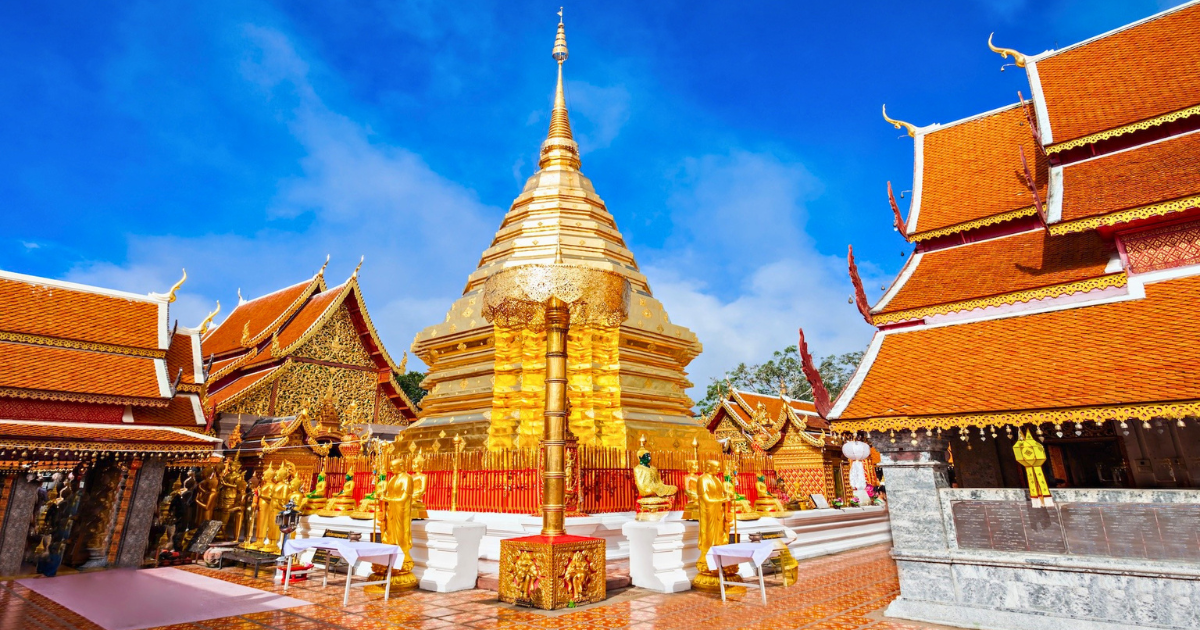
Founded in 1383, Wat Phra That Doi Suthep is the most significant Buddhist site in northern Thailand.
Why is Wat Phra That Doi Suthep important?
The temple's standing rests on the relic enshrined within its central chedi, the bell-shaped stone monument that forms the focal point of most Theravada Buddhist temples and is built to house sacred objects. The relic at Doi Suthep is believed to be a fragment of the Buddha's shoulder bone, and in Theravada Buddhism, sites that house authenticated relics carry particular weight. Doi Suthep is counted among the most sacred in Thailand, drawing pilgrims who circle the chedi three times while holding lotus flowers, incense and candles in a practice that has continued at the site for generations.
Beyond the relic, the Doi Suthep temple sits at the centre of Lanna religious identity. The Lanna kingdom ruled much of northern Thailand from the late 13th to the 18th century and developed its own schools of Buddhist practice, architecture and manuscript tradition that remained distinct from the Siamese court further south. Doi Suthep is the most prominent surviving expression of this lineage, and monks from across the north still train at the monastery today, which keeps the site connected to the religious life of the wider region rather than standing apart as a relic of the past.
That continuity is what sets the temple apart from many sacred sites in Thailand. Daily chanting, almsgiving and ceremonies continue much as they have for centuries, and during major Buddhist festivals, devotees walk the road from the city to the temple grounds through the night. The combination of religious weight and active practice is what gives the site its standing in northern Thailand today.
Beyond the relic, the Doi Suthep temple sits at the centre of Lanna religious identity. The Lanna kingdom ruled much of northern Thailand from the late 13th to the 18th century and developed its own schools of Buddhist practice, architecture and manuscript tradition that remained distinct from the Siamese court further south. Doi Suthep is the most prominent surviving expression of this lineage, and monks from across the north still train at the monastery today, which keeps the site connected to the religious life of the wider region rather than standing apart as a relic of the past.
That continuity is what sets the temple apart from many sacred sites in Thailand. Daily chanting, almsgiving and ceremonies continue much as they have for centuries, and during major Buddhist festivals, devotees walk the road from the city to the temple grounds through the night. The combination of religious weight and active practice is what gives the site its standing in northern Thailand today.
What is the legend of Doi Suthep?
The Doi Suthep history is one of the most widely told religious legends in northern Thailand. In the late 14th century, a monk named Sumanathera from Sukhothai is said to have discovered the relic and brought it north to King Keu Naone of the Lanna kingdom. When the relic was placed in a shrine for veneration, it reportedly broke into two pieces. One fragment was enshrined at Wat Suan Dok in the city, while the fate of the second piece was left to a more unusual decision.
According to the legend, the king placed the second piece on the back of a white elephant and released the animal into the forest, intending to build a temple wherever it stopped. The elephant climbed the slopes of Doi Suthep, trumpeted three times at a particular spot near the summit, and died on the ground where it had stood. King Keu Naone took this as a sign and ordered a chedi built on that exact location to house the relic.
The legend continues to shape how the Doi Suthep temple is understood today. White elephants are considered auspicious in Thai tradition, and the animal's choice of location is read as a form of divine guidance rather than a decision made by the court. The story is still told to visiting pilgrims as part of the temple's introduction, and a small shrine dedicated to the white elephant stands within the grounds.
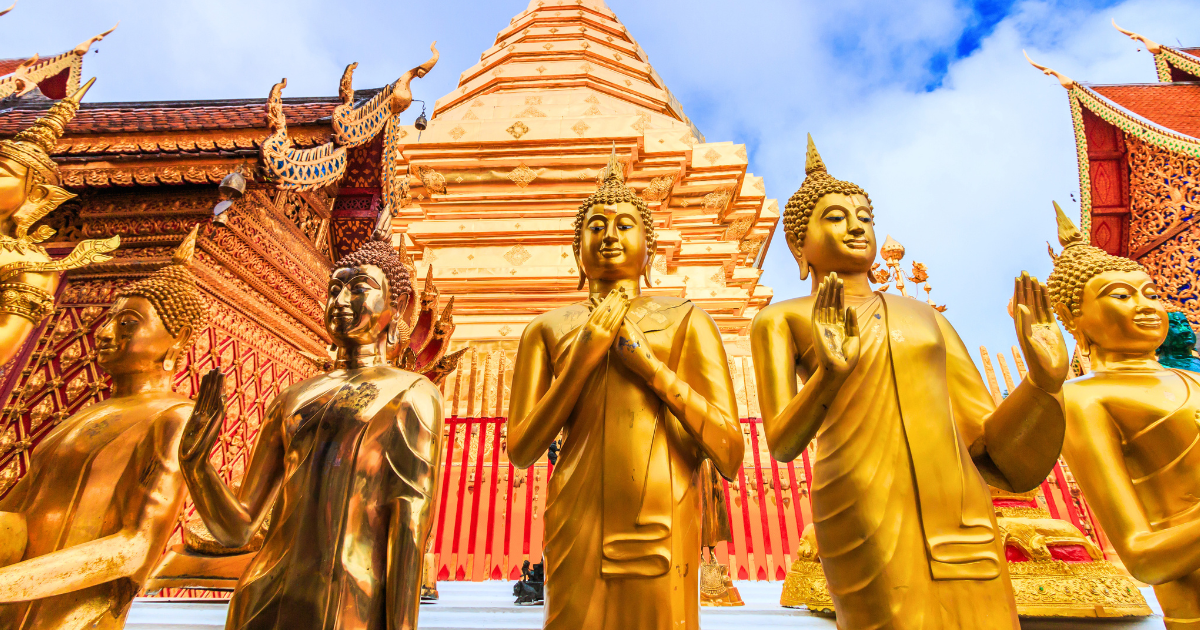
Gold is used in Buddhist art to reflect the pure light of the sun and to represent the incorruptible truth of the Dharma.
The history of Wat Phra That Doi Suthep
Behind the legend lies a documented history that traces the temple's development across more than six centuries. The complex has been expanded, rebuilt and reshaped many times since its founding, and even the road that now connects it to the city is less than a hundred years old, which helps explain why the site looks the way it does today.
When was Wat Phra That Doi Suthep founded?
The temple was founded in 1383 during the reign of King Keu Naone, the sixth ruler of the Mangrai dynasty that governed the Lanna kingdom from its capital at Chiang Mai. The kingdom had been established roughly a century earlier by King Mangrai, who consolidated the Tai principalities of the upper Mekong region into a single state in 1296. By the time of King Keu Naone, Lanna had become a centre of Theravada Buddhist scholarship, with strong ties to monastic communities in Sukhothai, Sri Lanka and Burma.
The original structure was modest in scale. It consisted of a single chedi built over the relic, surrounded by a small monastic enclosure. The site was already considered remote at the time of its founding, given the steep climb required to reach it, and access remained limited to monks and committed pilgrims for several centuries.
Who built Wat Phra That Doi Suthep?
The original chedi was commissioned by King Keu Naone, who oversaw the placement of the relic and the construction of the first shrine. Successive Lanna rulers expanded the complex over the following two centuries, adding the surrounding viharn, additional chedis and the monks' quarters that form the inner grounds today.
The figure most closely associated with the temple in modern memory, however, is Kruba Srivichai, a revered northern Thai monk who lived from 1878 to 1939. In 1935, he organised the construction of the road from the foot of the mountain to the temple gates, a project completed in five months through the labour of thousands of villagers from across the north who volunteered without payment.
The road transformed access to the temple and is the reason the site is reachable by vehicle today. A statue of Kruba Srivichai stands at the foot of the mountain road, and he remains one of the most venerated monastic figures in northern Thailand.
How has Wat Phra That Doi Suthep changed over the centuries?
The complex has been expanded and restored repeatedly since the original chedi was built. The chedi itself was raised in height during the 16th century, gilded with copper plates, and surrounded by additional shrines and ceremonial structures during successive periods of Lanna and later Siamese rule. The Naga staircase that now leads up to the entrance was added in the same century and remains one of the defining features of the approach.
After the Lanna kingdom came under Burmese control in the 16th century and later joined the Siamese kingdom in the late 18th century, the temple passed through several periods of neglect and renewal depending on the political circumstances of the day. Major restoration work was undertaken during the 19th and 20th centuries, including the rebuilding of the central chedi and the addition of the cable car in the 1990s, which now provides an alternative to the staircase for elderly pilgrims and visitors with limited mobility.
The temple today reflects the layered history of these contributions rather than a single architectural moment. The chedi remains the oldest and most sacred element, while much of the surrounding complex dates from the past two centuries.
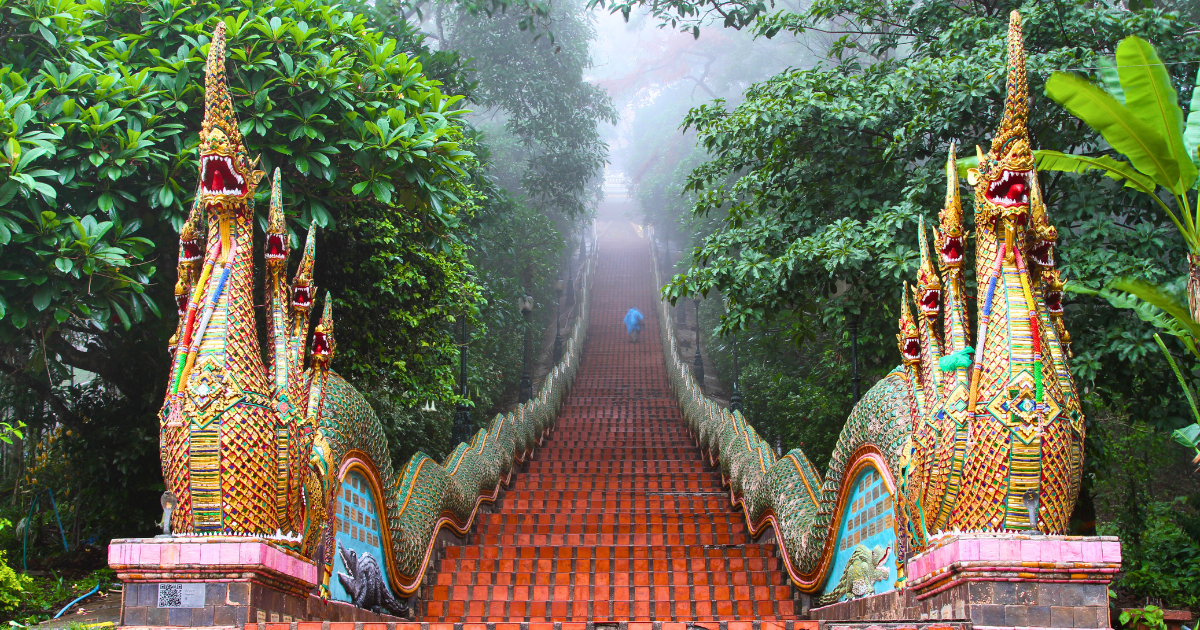
The Naga staircase was added during the 16th century, one of many features built onto the complex over the centuries.
What travellers can see inside the temple complex?
The grounds of Wat Phra That Doi Suthep are arranged across a series of terraces near the summit of the mountain, with the central chedi at the highest point and the supporting structures fanning out around it. Most visitors spend between one and two hours on the grounds, depending on whether they are observing ceremonies, walking the perimeter or pausing at the viewpoint that looks east across the valley.
The golden chedi
The chedi at the centre of the complex stands 24 metres high and is plated in gold leaf and copper, which is regilded periodically as part of the temple's ongoing maintenance. Its shape follows the Lanna style, with a square base, a tiered upper section and a slender spire crowned by a golden umbrella. Four ceremonial parasols, one at each corner of the inner courtyard, mark the cardinal directions and add to the visual structure of the space.
Pilgrims walk clockwise around the chedi three times in the practice known as pradakshina, holding lotus flowers, incense and small candles as offerings. Travellers are welcome to observe and to walk the same path, provided they remove their shoes before stepping onto the inner platform and conduct themselves quietly while ceremonies are underway.
The viharn and surrounding shrines
The viharn is the main prayer hall of a Thai temple, the open-sided structure where laypeople gather for ceremonies and where the principal Buddha images are housed. At Doi Suthep, the viharn sits to the east of the chedi and contains several seated Buddha images in the Lanna style, with murals along the interior walls depicting scenes from the temple's founding legend and from the life of the Buddha. The structure follows the open-sided form common to northern Thai prayer halls, with a steeply pitched roof and decorated wooden eaves carved in traditional patterns.
A smaller shrine dedicated to the white elephant from the founding legend stands within the grounds, alongside a number of secondary chedis, bell pavilions and statues of important monastic figures including Kruba Srivichai. Visitors can also see the bot, the ordination hall used by monks for formal ceremonies, although access to its interior is generally restricted.
The viewpoint over Chiang Mai
A terrace at the eastern edge of the complex looks out across the valley toward Chiang Mai. On clear days, the old city walls, the airport runway and the surrounding agricultural plains are all visible from this point, with the eastern hills forming the far horizon.
Visibility varies considerably with the season. The clearest skies are typically between November and February, while the months of March and April are often affected by smoke from agricultural burning across the region, which can reduce visibility to a few kilometres. Late afternoon, particularly during the cooler months, is the most popular time to visit the terrace, although the morning hours offer fewer crowds and softer light across the valley.
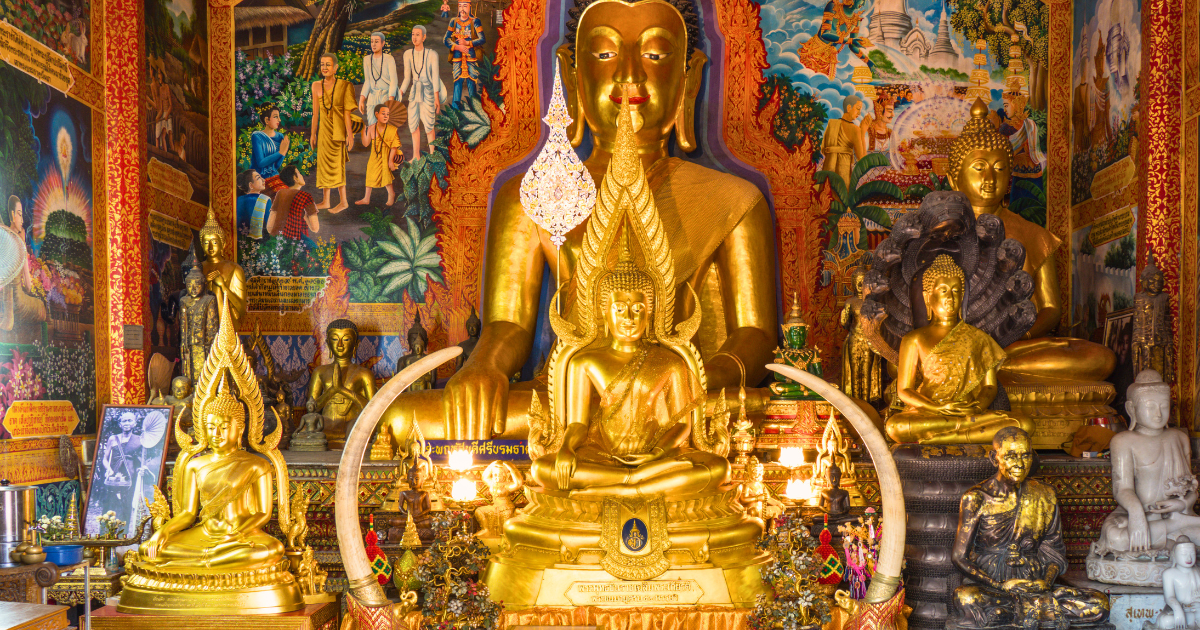
The main viharn houses seated Buddha images in the Lanna style, with murals depicting the temple's founding legend.
What travellers need to know before visiting Doi Suthep
A visit to Wat Phra That Doi Suthep is straightforward to arrange, though a few details are worth thinking through in advance. The site sits a short drive outside the old city, the approach involves a climb that adds to the experience of arrival, and the temple operates as an active monastery, which shapes the rhythms of dress and conduct on the grounds.
How many steps are there at Doi Suthep?
The Naga staircase leading up to the temple entrance has 306 steps, flanked on both sides by long balustrades shaped as multi-headed serpents. The naga figures are central to Buddhist iconography across the region and are traditionally regarded as protectors of the Buddha, which gives their presence at the entrance to a relic site particular meaning.
The climb is steady rather than strenuous and takes most travellers around five to ten minutes at a comfortable pace, with the staircase itself forming part of the experience for many pilgrims. A funicular tram also runs parallel to the staircase, carrying visitors directly to the temple grounds for a small fee. The tram is well used by older pilgrims, families with young children and travellers who prefer to save their energy for the grounds themselves.
Is Doi Suthep free to enter?
Entry to the temple grounds is free for Thai nationals, and foreign visitors pay a small fee of 50 baht (around 2.20 AUD). The funds support the ongoing care of the complex, including the reguilding of the central chedi and the maintenance of the surrounding shrines. The funicular tram operates separately and charges around 30 baht (around 1.30 AUD) for a return trip.
A simple dress code applies to all visitors, in keeping with the temple's status as an active place of worship. Shoulders and knees should be covered, and shoes are removed before entering any of the inner shrines. Sarongs and shawls can be borrowed at the entrance for travellers who arrive without suitable clothing. Quiet conduct is appreciated throughout the grounds, particularly near the chedi and within the viharn, and travellers are asked to seek a monk's permission before taking their photograph.
What is the dress code for Doi Suthep?
A simple dress code applies to all visitors, in keeping with the temple's status as an active place of worship. Shoulders and knees should be covered for both men and women, which means long trousers or skirts below the knee and tops that are not sleeveless. Lightweight clothing is generally the most comfortable choice given the climb and the warmth of the day.
Shoes are removed before entering any of the inner shrines, so footwear that slips off easily is more practical than laced shoes. Sarongs and shawls can be borrowed at the entrance for travellers who arrive without suitable clothing, though wearing appropriate dress from the start makes the visit more comfortable.
What is appropriate conduct at Doi Suthep?
The temple is an active monastery, and conduct on the grounds is expected to reflect that. Quiet behaviour is appreciated throughout the complex, particularly near the chedi and within the viharn, where pilgrims may be praying or making offerings. Voices should be kept low and phones set to silent.
When walking around the chedi, the traditional direction is clockwise, in keeping with the practice of pradakshina. Travellers are welcome to follow the same path or simply observe from one side. Photographs of the grounds and the buildings are permitted, although travellers are asked to seek a monk's permission before photographing them directly. Pointing the feet toward Buddha images or seated monks is considered disrespectful, so sitting cross-legged or with feet tucked behind is the standard posture when resting in any of the shrines.
How do I get to Doi Suthep from Chiang Mai?
Wat Phra That Doi Suthep lies around 15km from the old city, a pleasant drive of 30 to 45 minutes depending on traffic. The road follows the route built by Kruba Srivichai in 1935 and winds through the forested slopes of Doi Suthep-Pui National Park before arriving at the parking area below the staircase.
Most travellers reach the temple by one of three means. Songthaews, the red shared trucks that operate as informal taxis around Chiang Mai, can be hired from Chang Phueak Gate, with fares usually agreed before departure. Private cars with drivers offer a more comfortable option and allow for stops at other sites on the mountain, including the royal residence at Phuping Palace and the Hmong village of Doi Pui higher up the road. Travellers on a structured itinerary will generally have transport arranged in advance.
Early morning is a particularly rewarding time to visit, when the grounds are quieter and the monks are conducting their morning chanting. Late afternoon is equally well suited to the climb, with softer light settling over the valley once the heat of the day has eased. The temple opens at 6:00am and closes at 6:00pm, with some shrines remaining open later during major Buddhist holy days.
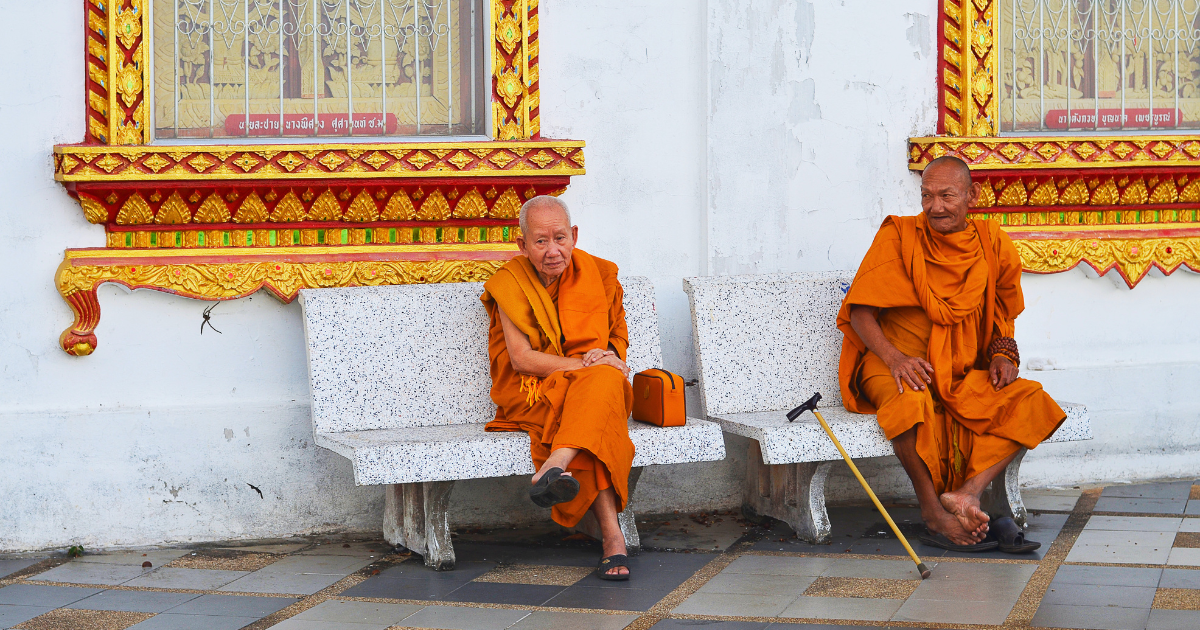
The temple operates as an active monastery, which shapes the dress code and conduct expected of visitors on the grounds.
Visiting Doi Suthep with Remarkable East
Remarkable East small group tours, with a maximum of 12 guests per departure, include a private guided visit to Wat Phra That Doi Suthep as part of our Thailand Wellness Retreat. Each trip is led by an expert host who brings cultural context and historical depth to every visit, alongside time at Aleenta Retreat Chiang Mai and other selected sites across the region.
If you would like to learn more about our Thailand Wellness Retreat or talk through future departures, book a call with our team and we will walk you through the itinerary, dates and what to expect on the ground.