
5 Of The Best Day Trips From Matsuyama
Ehime sits on the north-western coast of Shikoku, the smallest of Japan's four main islands, facing the calm waters of the Seto Inland Sea. At its centre is Matsuyama, the largest city on Shikoku and the prefectural capital, best known for Dogo Onsen and a feudal-era castle that still stands on the hill above the streets. Most travellers spend a day in Matsuyama, then find that the surrounding region holds more than they initially expected.
The best places to visit in Ehime tend to sit beyond the city itself, and the prefecture rewards the time spent reaching its quieter corners. Within an hour or two of Matsuyama lie preserved Edo and Meiji townscapes, a cycling route that crosses the Seto Inland Sea by bridge, one of Japan's seven sacred mountains, and a town built around a single craft. Each works as a day trip, and several can be reached by train without any need to drive.
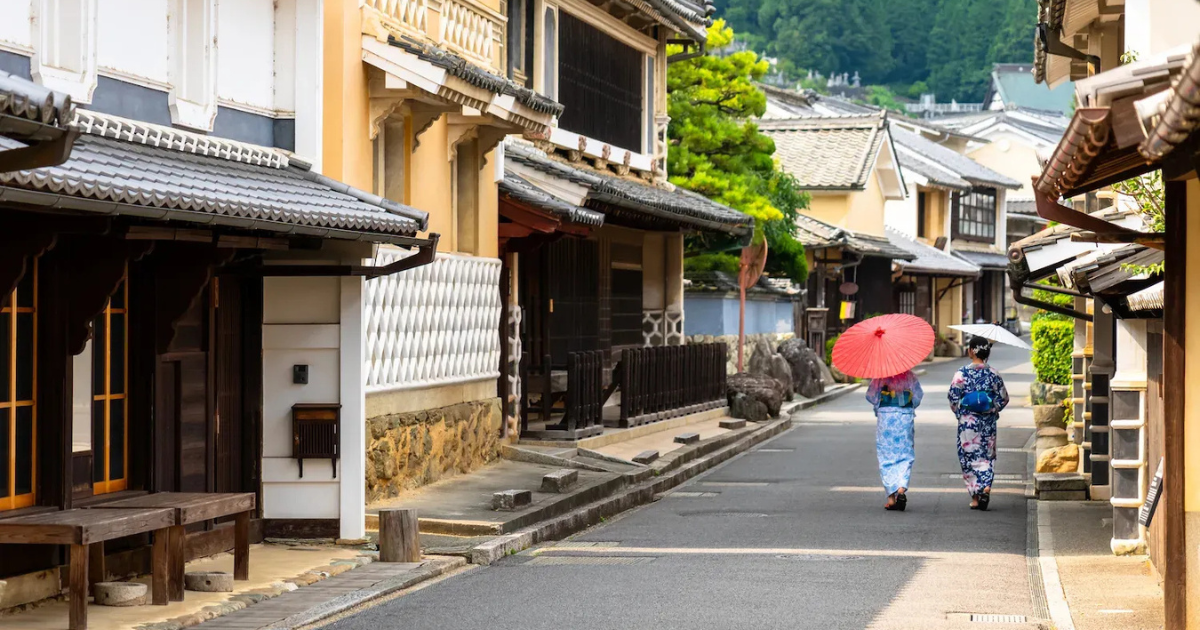
The Yokaichi district in Uchiko preserves the merchant houses that the wax trade built during the Edo and Meiji periods.
What are the best day trips from Matsuyama?
Ehime's appeal comes from how different its corners are from one another, and Matsuyama puts most of them within a day's return journey. Heading south leads to preserved towns that grew wealthy on wax and trade, the coast opens onto the bridges and islands of the Seto Inland Sea, and the mountainous interior holds a sacred peak that has drawn pilgrims for centuries. Closer to the city, a small town has worked the same porcelain tradition for more than two hundred years.
Uchiko and its preserved merchant streets
Uchiko is about 40 minutes south of Matsuyama by train on the JR Yosan Line. During the Edo and Meiji periods it became one of the largest producers of plant-based wax in Japan, pressed from the berries of a local sumac tree called the hazenoki. At the industry's peak, the town's 23 wax merchants accounted for around 30 percent of national production, and the Kamihaga family went on to exhibit a refined white wax at the 1900 Paris Expo before exporting it to Europe and America.
The wealth from this trade is still visible in the Yokaichi district, a 600-metre street of merchant houses with white-plastered walls, latticed windows and heavy tile rooflines. The Kamihaga Residence, now a museum, explains the wax-making process across the rooms of the family compound. A short walk further stands the Uchiko-za, a wooden playhouse built in 1916 for kabuki, the classical Japanese theatre known for its stylised acting and elaborate staging. The theatre is closed for conservation until around 2028, though a backstage exhibition lets visitors see the revolving stage and the trap mechanisms beneath the floor.
The wax industry declined after petroleum-based paraffin replaced plant wax in the early twentieth century, which is partly why the town never grew beyond the footprint its merchants left behind. The Omori Warosokuya workshop, now in its sixth generation, is the only remaining producer of traditional wax candles in Ehime, and visitors can watch the candles being hand-dipped on the wooden workshop floor. Several of the old merchant houses now operate as cafes serving local dishes, and the town covers comfortably on foot in a few hours.
Ozu and the riverside castle town
Ozu is one stop further along the same rail line and pairs well with Uchiko in a single day. The town grew around its castle, which was demolished in the late nineteenth century and then rebuilt in 2004 after a grassroots campaign by local citizens. The reconstruction used old photographs, surviving schematics and a wooden model from the Edo period, and the builders worked with traditional timber joinery rather than the reinforced concrete used in most Japanese castle restorations.
From the castle it is a short walk to Garyu Sanso, a private villa and garden built in the early twentieth century by a merchant who made his money in wax and silk. The craftsmanship in the buildings is finer than in most public buildings of the same period, with carefully chosen timbers and detailed joinery throughout. The tea house sits directly over the Hijikawa River, and the garden path shifts the view at each turn.
Beyond the castle and the villa, the town has found ways to bring its older buildings back into use. Several restored Edo-period mansions and merchant houses now form part of the Nipponia Hotel Ozu Castle Town, a decentralised hotel with rooms scattered through the streets rather than gathered in one building. Garyu Brewing, a craft brewery in a former silk warehouse by the river, is one of several businesses that have reopened old properties as cafes, sake breweries and shops. In the evenings from June to September, small boats go out on the river for ukai, a traditional form of fishing using trained cormorants that dive by torchlight.
The Shimanami Kaido and Imabari
The Shimanami Kaido is a 70km chain of bridges and islands that crosses the Seto Inland Sea from Imabari to Onomichi on Honshu. It is widely regarded as one of the best routes for cycling in Japan, with a dedicated path that runs on its own lane separate from traffic across each bridge. Imabari is between 40 minutes and an hour north of Matsuyama by train, and most visitors hire a bicycle at the terminal before setting out. The full crossing takes around six to seven hours at a steady pace, though most day trippers cover two or three islands rather than the whole distance.
The largest of the bridges is the Kurushima-Kaikyo, three suspension spans with a total length of just over four kilometres. When it opened in 1999 it was the longest suspension bridge structure in the world. The strait it crosses has a long maritime history. During the Sengoku period, the Murakami clan controlled shipping through these narrows for over a century, exacting tolls on every vessel that passed through.
Travellers not cycling can reach Oshima island from Imabari by bus. Kirosan Observatory at the top of Mount Kiro gives a wide view over the bridge, the surrounding islands and the shipping channels between them. On a clear day the view reaches inland as far as Mount Ishizuchi, and the bridge is lit after dark on a set schedule.
Mount Ishizuchi and Saijo
Mount Ishizuchi rises 1,982 metres inland to the east, the highest peak in western Japan and one of the country's seven holy mountains. It has been a place of Shugendo pilgrimage for more than a thousand years. Shugendo combines mountain ascent with Buddhist and Shinto ritual, and during the annual Mountain Opening festival from July 1 to 10, practitioners still climb in white robes with conch horns, following the same routes their predecessors walked centuries ago. Most visitors approach from the Saijo side, either a 90 minute drive from Matsuyama or a train to Iyo-Saijo Station followed by a seasonal bus.
A cable car from Nishi-no-Kawa carries walkers up the lower slopes to Jojusha Shrine at around 1,300 metres. From there the summit is a further two and a half to three hours on foot. The route passes four sets of heavy iron chains fixed to near-vertical rock, the first a trial set to test ability and three official sets beyond it. The longest chain runs to 68 metres. Fixed stairs run alongside each set for those who prefer them.
The climbing season runs from July to October, with October the busiest month for the autumn colour on the upper slopes. Saijo at the base of the mountain is worth an hour after the descent. The town is known for its uchinuki, underground wells that push clean groundwater up to the surface and feed open channels through the older streets.
Tobe and its pottery tradition
Tobe is the closest of the five, around 30 minutes south of Matsuyama by bus or car. The town has produced porcelain since the 1770s, when the local Ozu domain began firing pottery from offcuts of Iyo whetstone to supplement its income. The area sits on the Median Tectonic Line, a major geological fault running the length of southwest Japan, and the pottery stone it produced gave Tobe what it needed. The same fault supplied Arita in Kyushu, one of the better-known porcelain centres in the country.
The local ware is called Tobe-yaki. It is recognisable by its white ground painted with patterns in indigo blue. The pieces are thick and sturdy, made for everyday kitchen and table use rather than display. Around 80 kilns operate in the town today, many working in the traditional style while a younger generation of potters has taken it in newer directions.
Several of the kilns are open to visitors. The Tobe-yaki Tourist Center and the Tobe Pottery Hall both sell pieces and run workshop sessions on the wheel or in hand-painting a plate or cup. The heritage centre holds an archive of work from across the tradition's two and a half centuries, set alongside pieces by the younger potters, which gives a clear sense of how the style has developed. A couple of hours covers a workshop and time to choose something to take home.
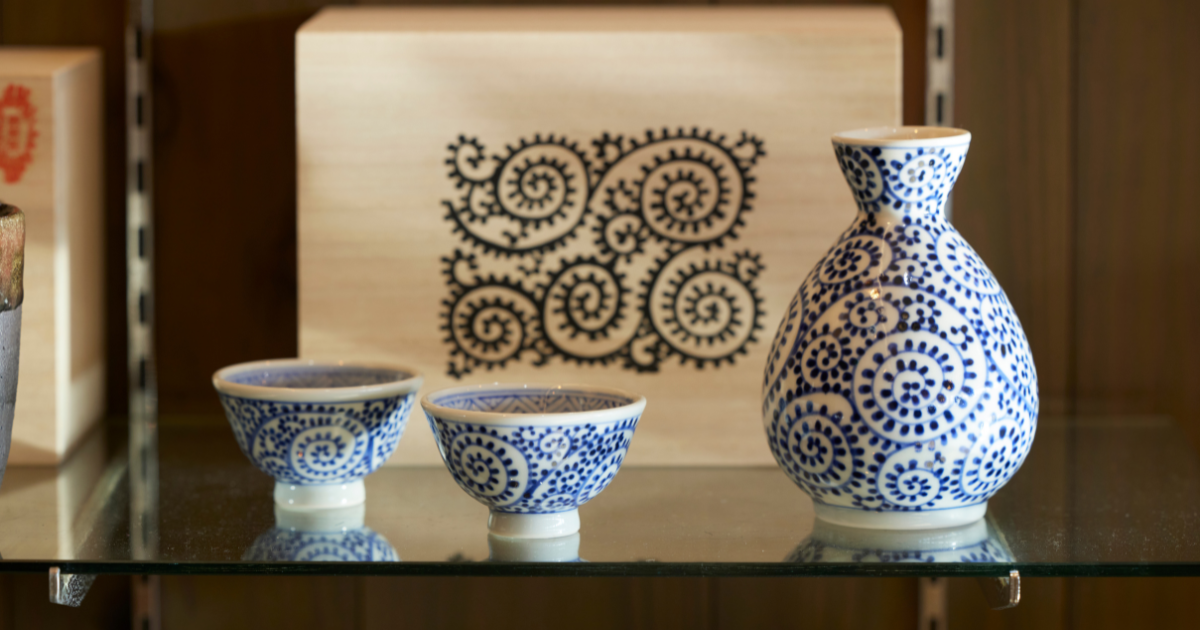
Tobe-yaki is recognisable by its indigo patterns on white porcelain, the pieces made for everyday use since the 1770s.
What are the best traditional towns to visit in Ehime?
Japan protects its older townscapes through a national system. Areas with a high number of surviving historic buildings can be listed as Preservation Districts for Groups of Traditional Buildings, which limits what owners can change and helps fund repairs. Several of the best-known traditional towns in Japan, such as Takayama and Kanazawa, are protected this way, and Ehime has its own set of listed and historic districts. Among the places to visit in Ehime, four traditional towns are worth knowing.
Uchiko
Uchiko's Yokaichi-Gokoku district is one of these nationally listed preservation areas, which is the main reason its merchant street has survived largely unchanged. The houses are built in a style local to the region, with pale plastered walls, ground-floor lattice screens and fire-resistant storehouses set behind. Some of the grandest items were raised by wax merchants in the eighteenth and nineteenth centuries, and their size and detailing reflect how much money the wax trade brought in. The district is still lived in, with homes and shops among the listed buildings rather than a street given over entirely to visitors.
Ozu
Ozu kept the layout of a castle town, with the streets below the keep still following their old divisions between merchant and samurai quarters. The buildings range from Edo-period merchant houses to early twentieth-century additions, and several have been restored and put back into use as accommodation and shops rather than left as exhibits. The town reads as a working place that has held on to its older fabric, helped by its setting on the Hijikawa River, which shaped where the streets and quarters could go.
Uwajima
Further south, about 80 to 90 minutes from Matsuyama by limited express, Uwajima grew up around its castle and harbour. The castle keep is one of only twelve in Japan to survive from the Edo period, a small three-storey tower built by Todo Takatora around 1601 and rebuilt under the Date clan in the 1660s. The town below was the seat of the Date domain for more than two centuries, and its economy still leans on the sea, with pearl farming and citrus among the main local industries. The keep sits on a wooded hill in the middle of town and looks out towards the mountains and the coast.
Unomachi
Unomachi, in the town of Uwa within Seiyo City, is around an hour south of Matsuyama by train and was once the only post town in the Uwajima domain. Its main street is a listed preservation district of merchant houses dating from roughly 1740 onward, built in traditional styles with white walls, lattice screens and the raised firebreak walls known as udatsu. The street also holds older institutions, including the Kaimei School of 1882, one of the first primary schools in Shikoku, and sake breweries and shops that have traded for generations. It sees fewer visitors than Uchiko or Ozu, so it keeps more of the character of an ordinary working town.
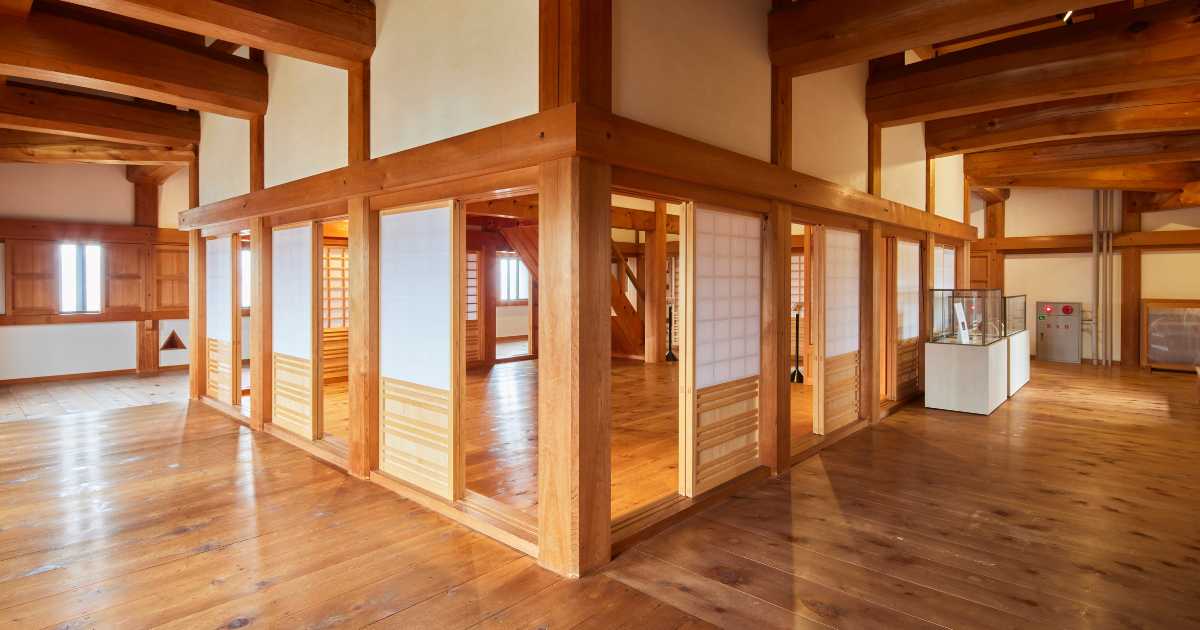
Ozu Castle was rebuilt in 2004 using traditional timber joinery rather than the reinforced concrete used in most Japanese castle restorations.
Is Matsuyama a good base for exploring Ehime?
Yes, Matsuyama works well as a base for exploring Ehime. As the prefectural capital and the largest city on Shikoku, it has the range of accommodation, food and services compared to smaller towns nearby, and it sits where the region's main transport lines converge. The city also has its own airport on its southwestern edge, around 15 minutes from the central stations by bus, with domestic flights to Tokyo, Osaka and other Japanese cities and a few international routes, which makes it straightforward to reach at the start of a trip and leave at the end.
Within the city, two stations handle most journeys out to the rest of the prefecture. JR Matsuyama Station, west of the centre, runs the JR lines that head south to Uchiko, Ozu and Uwajima and east towards Saijo. Matsuyama City Station, the hub of the private Iyotetsu network in the centre of town, handles local trains and the trams that connect the two stations with Dogo Onsen and the castle. Knowing which station a trip departs from is the main thing to get right, as the two are run by different operators and sit a short tram ride apart.
The range of day trips reachable from these stations is what makes the case. The preserved towns to the south, the islands and bridges of the Shimanami Kaido to the north, Mount Ishizuchi to the east and the pottery town of Tobe close by are all comfortable returns within a day. A traveller can spend a week working outward from the city and cover a broad cross-section of the prefecture without ever needing to relocate. A Matsuyama itinerary built around day trips tends to come together well for exactly this reason.
How to travel around Ehime from Matsuyama?
Most day trips from Matsuyama are reached by rail, with a scenic coastal train and hire cars adding range and flexibility. Which suits a given day depends on where you are heading and how much of the journey you want to be part of the experience.
By rail
The JR Yosan Line is the main route out of the city. Running south from JR Matsuyama Station, it reaches Uchiko in about 25 minutes and Ozu in about 35 by limited express, then continues to Uwajima in around 80 to 90 minutes. The same line runs east towards Saijo, the usual approach for Mount Ishizuchi. Services on the southern stretch are frequent, so Uchiko and Ozu combine easily in a day, while the Uwajima trains run roughly hourly and are worth checking before setting out.
The Shimanami Kaido is the exception to the southern routes, reached by heading north to Imabari, 40 minutes to an hour away, from where the islands are crossed by bicycle, bus or car. Travellers planning several rail trips can use the All Shikoku Rail Pass, which covers JR Shikoku services and the Iyotetsu trains and trams around the city on unreserved seats.
By scenic train
The Iyonada Monogatari runs along the coast between Matsuyama and Ozu or Yawatahama. It is built around the views of the Seto Inland Sea and serves meals on board, with reservations required in advance. The train is slower than the standard limited express and works as an experience in its own right rather than a way of covering distance, which suits an unhurried day heading south. It is not included in the rail pass and needs separate booking.
By car or private tour
A car or private guide opens up the parts of the prefecture that rail reaches less directly. Tobe is served by bus rather than train, and the buses to the Mount Ishizuchi ropeway run seasonally from the Saijo side, so a car gives easy access to both at any time of year. A Japan small group tour offers the same freedom and makes it possible to combine destinations the timetable keeps apart, such as pairing Tobe with a town further south in a single day. For the quieter corners of Ehime, this is often what makes a fuller day possible.
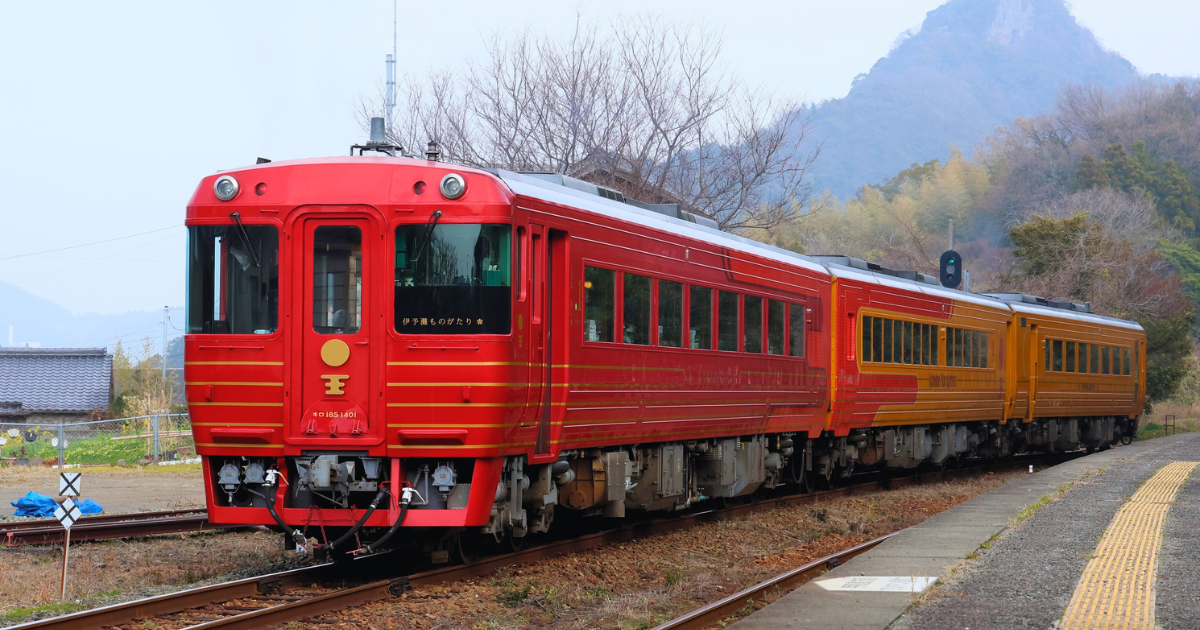
The Iyonada Monogatari runs along the coast between Matsuyama and Ozu, serving meals on board with views of the Seto Inland Sea.
Planning day trips from Matsuyama with Remarkable East
Remarkable East designs small-group journeys through Japan, with each departure limited to 12 guests and led by guides who know the region well. Travelling this way makes the quieter parts of Ehime straightforward, with the logistics handled and each day shaped around what is worth seeing.
Our Japan small group tour spends time in Matsuyama, Ozu and Uchiko, with washi paper making in Uchiko and a route through the castle towns before crossing the Seto Inland Sea towards Kyushu. To plan a journey through Ehime, get in touch with the Remarkable East team or explore our small group departures across Japan.