
The Origins Of The Prince Of Wales Museum In Mumbai
Mumbai's Fort district carries the dense architectural record of the city's nineteenth and early twentieth century rise as the commercial capital of British India. Within a short walk of one another sit Elphinstone College, the David Sassoon Library, the High Court and the University of Bombay, all built during a period when Bombay's mercantile wealth was being channeled into civic institutions. The cultural quarter around Kala Ghoda, at the southern edge of this district, took shape in the same period.
Among the most substantial projects of these years was a new public museum, conceived before the First World War and opened to the public in 1922. Today it operates as the Chhatrapati Shivaji Maharaj Vastu Sangrahalaya, or CSMVS, and holds one of the largest museum collections in India. It was built and inaugurated, however, under a different name: the Prince of Wales Museum of Western India.
How the museum came into being sits at the centre of how Bombay's civic class imagined the city in the early twentieth century. Funded jointly by the colonial government and the city's leading Indian and Parsi merchants, and designed by the same architect responsible for the Gateway of India, the museum has a founding history more involved than its current name suggests.
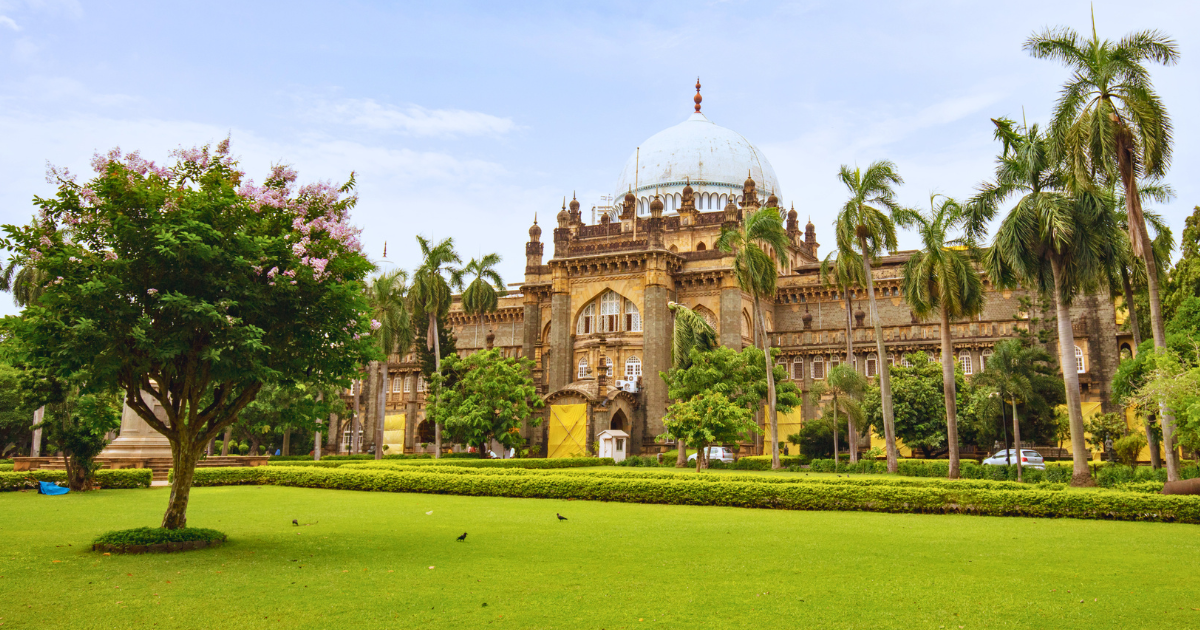
The Chhatrapati Shivaji Maharaj Vastu Sangrahalaya building was largely complete by 1915 but served as a military hospital throughout the First World War before the galleries opened to the public in January 1922.
What is the Prince of Wales Museum and where is it located?
The Prince of Wales Museum, now CSMVS, is a public museum of art, archaeology and natural history in the Fort district of south Mumbai. It holds roughly 70,000 objects across three founding departments and ranks among the largest museum collections in India. The building was designed as a museum from the outset, which sets it apart from many older Indian museums housed in converted palaces or colonial residences.
The building sits on a wedge-shaped plot at the southern end of Mahatma Gandhi Road, set back from the street within its own walled garden. Elphinstone College and the Jehangir Art Gallery stand to the north, with the Royal Bombay Yacht Club and the Gateway of India a short walk to the south. The nearest railway stations are Churchgate on the Western Line and Chhatrapati Shivaji Maharaj Terminus on the Central Line, each around fifteen minutes on foot.
The main building is listed as a Grade I heritage structure under Mumbai's municipal heritage regulations and forms part of the Victorian Gothic and Art Deco Ensembles of Mumbai, inscribed as a UNESCO World Heritage Site in 2018. The compound also includes a separate children's museum and a coin gallery added in later decades.
The early history of the Prince of Wales Museum
The Prince of Wales Museum was founded in 1905, when the future King George V, then Prince of Wales, laid the foundation stone during a royal visit to Bombay. The building was largely complete by 1915 but spent the First World War as a military hospital, and only opened to the public in January 1922.
Why was the Prince of Wales Museum built in Bombay?
By the late nineteenth century, Bombay had become the commercial capital of British India, with a wealthy mercantile class drawn from Parsi, Gujarati, Jewish and Marwari communities. The city already held two notable collections, one at the Asiatic Society of Bombay in Town Hall and the other at the Victoria and Albert Museum in Byculla, now known as the Bhau Daji Lad Museum. Neither, however, sat within the commercial Fort district where most civic life was concentrated.
The case for a new Mumbai museum in Fort was made by a committee of local merchants and members of the Royal Asiatic Society in the early 1900s. The royal visit of November 1905 provided the moment to formalise the project. The Prince of Wales, later King George V, laid the foundation stone on 11 November 1905, and the institution was named in his honour. Funding came from a combination of government grants and public subscription, with major contributions from Sir Currimbhoy Ebrahim, Sir Cowasji Jehangir and the Sassoon family.
Who was the architect of the Prince of Wales Museum?
The design was chosen through an open competition held in 1909, won by George Wittet, a Scottish architect who served as consulting architect to the Bombay government from 1907. Wittet was already engaged on what would become his best-known commission, the Gateway of India, and went on to design the nearby Institute of Science. The brief called for a building that read as Indian in character while functioning as a modern museum, with the high galleries and controlled light suited to a large permanent collection.
Wittet responded with a design in the Indo-Saracenic style, a hybrid developed by British architects in late nineteenth century India that combined Indian decorative elements with European building plans. The central dome is modelled on the seventeenth-century Gol Gumbaz at Bijapur, and the facade carries jharokha balconies, the projecting stone windows of Rajasthani palace architecture, beneath chhajja eaves designed to throw monsoon rain clear of the walls. The building is constructed from locally quarried basalt and yellow Malad stone.
When did the Prince of Wales Museum open to the public?
Construction began shortly after the design competition and the main building was largely complete by 1915. The galleries were not yet fitted out, however, and the outbreak of the First World War led the Bombay government to requisition the building for war service. It functioned as a military hospital and a children's welfare centre from 1915 until 1920, with the unfurnished galleries serving as wards.
The building was returned to its intended purpose in 1920. After two years of fitting out the displays and bringing in the founding collections, the museum was formally opened to the public on 10 January 1922 by Lady Lloyd, wife of the then Governor of Bombay, Sir George Lloyd. The institution had been seventeen years in the making from the laying of the foundation stone.
How the Prince of Wales Museum grew after 1922
After opening in 1922, the museum grew primarily through major bequests from Bombay's industrialist families, with its collection doubling within the first decade. The building itself was extended and renovated through the following century, ending with a major restoration completed in the late 2000s.
What were the major bequests to the museum after 1920?
Sir Ratan Tata's bequest in 1921, made shortly before the museum opened, brought a substantial collection of European paintings and decorative arts that became the core of the art section. A second bequest from his brother Sir Dorabji Tata in 1933 added further decorative arts along with Indian objects, doubling the museum's holdings within its first decade of operation.
Smaller but historically significant donations followed throughout the twentieth century, including the Karl and Meherbai Khandalavala collection of miniature paintings, which brought important Mughal, Rajput and Pahari works into the museum's hands. The natural history galleries developed through the 1920s with hand-painted dioramas commissioned from local artists, several of which remain on display in their original form.
How did the museum change after Indian Independence?
A separate children's museum opened within the compound in 1937, one of the earliest dedicated children's spaces in an Indian museum. After Independence in 1947, the institution gradually reorganised its founding departments and placed greater emphasis on Indian art and archaeology in its displays.
The natural history wing was retained as a distinct section rather than absorbed into a separate science museum, which preserved its early dioramas and habitat groups intact. Acquisitions during these decades continued through both purchase and donation, with growing attention to Indian sculpture, manuscripts and decorative traditions.
When was the museum restored?
By the late 1980s, the building had been weakened by decades of monsoon damage and deteriorating stonework. A major restoration programme began in the late 1990s under the directorship of Sabyasachi Mukherjee, working with conservation architects and craftsmen to repair the basalt and Malad stone facades and update the internal display environments.
The work continued into the 2000s and concluded with the 2010 UNESCO Asia Pacific Award of Merit for cultural heritage conservation. The restoration was part of a wider institutional shift, with the museum presenting itself as a research-led public institution in the lead-up to its centenary in 2022.
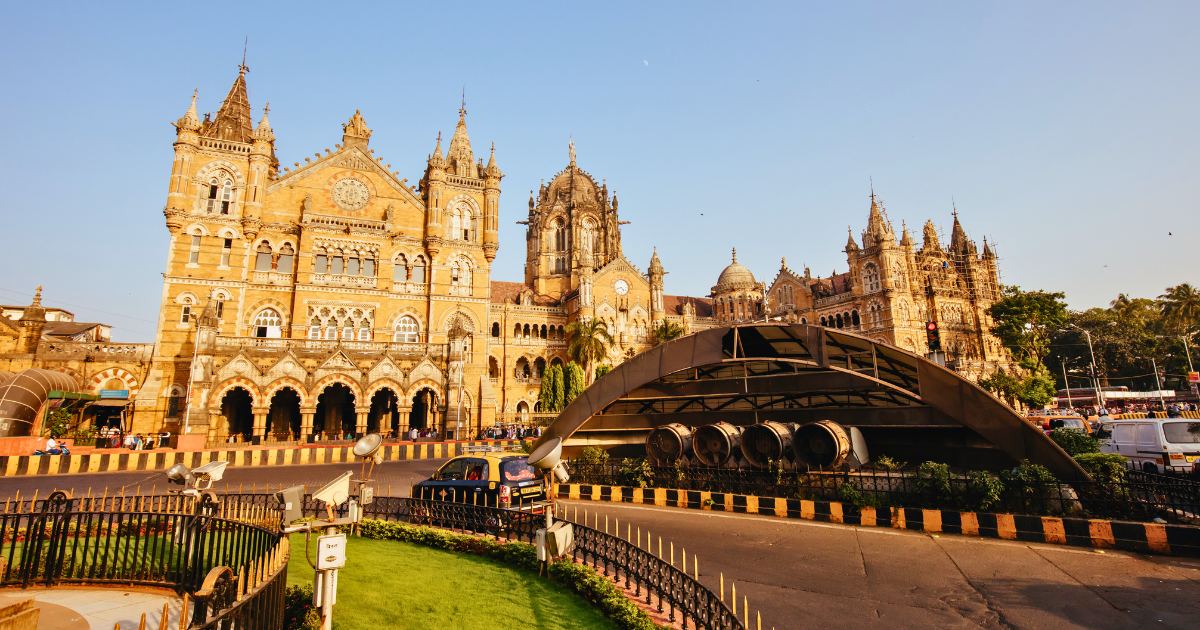
Chhatrapati Shivaji Maharaj Terminus, formerly Victoria Terminus, was renamed in the same wave of civic renaming that gave the museum its current name.
Why was the Prince of Wales Museum renamed to CSMVS?
The museum was renamed in 1998 to honour the seventeenth-century Maratha king Chhatrapati Shivaji Maharaj. The change followed a wider adoption of Marathi historical names by civic institutions in Maharashtra during the 1990s. By the time the museum was renamed, Bombay had already become Mumbai in 1995, and Victoria Terminus station had been renamed Chhatrapati Shivaji Terminus in 1996.
The Maharashtra state government, then led by the Shiv Sena, supported the renaming of several public institutions during this period. Many of these buildings had retained their colonial-era titles long after Independence, and the change was understood as a way of reflecting Marathi heritage in the names of civic and cultural landmarks. The Prince of Wales Museum was among the most prominent institutions to be renamed.
The original name has remained in common use. Many Mumbai residents and long-running tourist guides still refer to the institution as the Prince of Wales Museum, and the museum's own signage acknowledges both.
What is inside the CSMVS museum?
The CSMVS in Mumbai holds around 70,000 objects across four main collection areas. The galleries follow a roughly chronological and thematic arrangement across three floors of the main building.
Indian sculpture and the Indian art history galleries
The Indian sculpture galleries form the largest single section of the museum and provide an introduction to Indian art history through stone, bronze and clay. The collection includes Gandhara Buddhist sculpture from the first to fifth centuries, where the influence of Hellenistic art on Indian Buddhist iconography is visible in the draped robes and naturalistic facial features. Chola bronzes from southern India, dating mostly between the ninth and thirteenth centuries, sit alongside Hoysala and Pala stone sculptures from later medieval periods.
The miniature painting galleries hold work from the major schools of Indian painting, including Mughal court scenes, Rajput devotional and narrative work, and Pahari miniatures from the Himalayan foothills. The Karl and Meherbai Khandalavala collection adds significantly to these holdings, particularly in the Rajput and Deccani traditions.
Pre and proto historic antiquities
The pre-Harappan and Harappan galleries hold material from the Indus Valley civilisation excavated at Mohenjo-daro, Lothal and other sites dated between roughly 2600 and 1900 BCE. The collection includes terracotta figures, carved seals, beads and fragments of painted pottery, with several pieces representing some of the earliest evidence of urban material culture in the subcontinent.
The numismatic gallery holds one of the largest coin collections in India, with Indo-Greek and Kushan issues from the early centuries CE, Gupta-period gold coinage, sultanate and Mughal silver, and colonial-period currency. The arrangement lets the visitor track changes in coinage and political authority over two thousand years.
Decorative arts, European paintings and arms
The decorative arts section comes largely from the bequests of Sir Ratan Tata in 1921 and Sir Dorabji Tata in 1933, both of whom collected widely across Europe and Asia. The galleries include jade and ivory carving, Chinese and Japanese porcelain, European glass and silver, and Indian textiles such as court costumes and embroidered cloth.
The European painting holdings include works by Dutch, Italian and British artists from the sixteenth to nineteenth centuries, brought to Mumbai through the Tata collections and later donations. The Arms and Armour gallery, displayed in a separate hall, holds Indian swords, daggers and shields alongside helmets and armour attributed to Mughal and Maratha rulers including Akbar and Shivaji.
Natural history section
The natural history wing remains one of the few sections of its kind operating in an Indian art museum, retaining the displays installed in the 1920s. The original hand-painted dioramas show Indian wildlife in their habitats, including tigers in dry deciduous forest, blackbuck on the open plains and birds of the Western Ghats.
The educational character of the displays reflects the founding-era idea of a natural history museum as a public learning institution rather than a research facility. The dioramas have been maintained largely in their original form, which makes the section one of the older surviving examples of museum natural history display in the country.
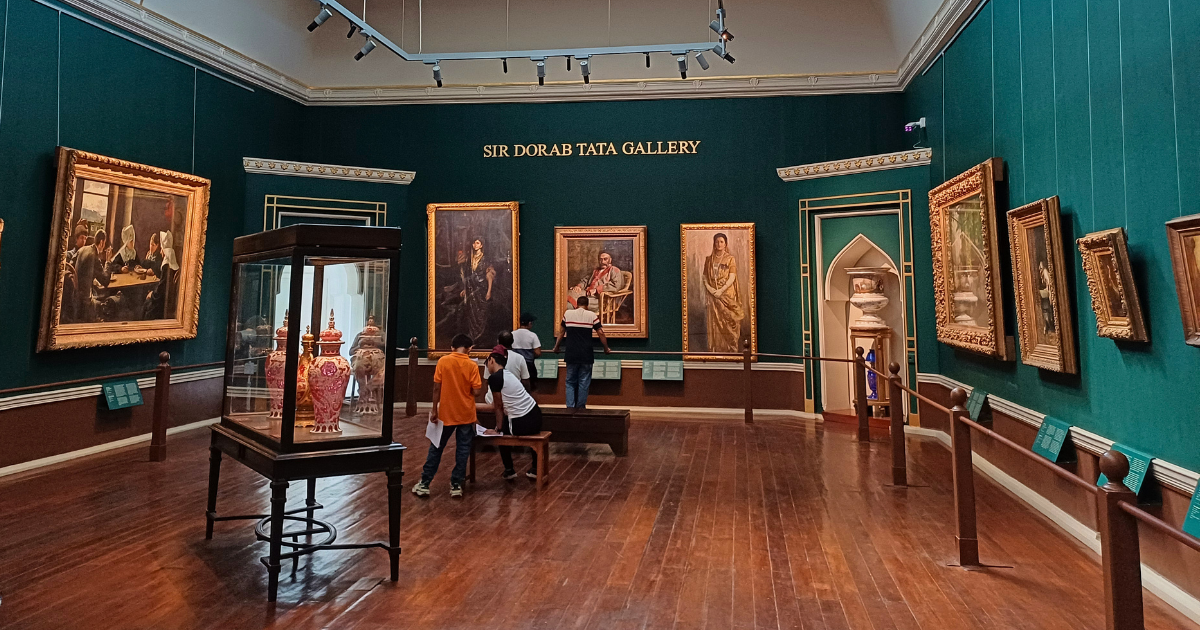
The Sir Dorab Tata Gallery on the second floor houses part of the collection bequeathed to the museum in 1933.
Visiting the Prince of Wales Museum
This Mumbai museum is open daily and is located on Mahatma Gandhi Road in the Fort district of south Mumbai. A visit of two to three hours covers the main galleries across the three floors and the separate Arms and Armour hall, often as part of a North India small group tour.
Is the Prince of Wales Museum open today?
The museum is open every day from 10:00am to 6:00pm, with the ticket counter closing at 5:45pm. It is closed only on three national holidays each year: Republic Day on 26 January, Independence Day on 15 August, and Gandhi Jayanti on 2 October. Current opening times and any temporary closures for installations or events are listed on the official CSMVS website.
What is the entry fee for the museum?
Foreign visitors pay approximately $10 AUD for adults and $3 AUD for children, with the price including a complimentary audio guide. Indian residents pay around $2 AUD for an adult ticket and $.50 AUD for a child ticket, with audio guide hire at an additional $3 AUD. Audio guides are available in English, Hindi, Marathi, French, German, Japanese and Spanish.
Photography in the galleries is permitted with a mobile phone for a small additional fee, while a separate camera or tripod incurs higher charges. Entry is free for differently-abled visitors and for accompanied children below the age of five, and the building is wheelchair accessible with lifts to all floors.
How do you reach the museum?
The museum is at 159–161 Mahatma Gandhi Road, in the Fort district of south Mumbai. The two nearest commuter railway stations are Chhatrapati Shivaji Maharaj Terminus on the Central Line and Churchgate on the Western Line, each about a fifteen-minute walk away.
Many visitors arrive on foot from the Gateway of India, about ten minutes south, or combine the museum with the Jehangir Art Gallery and the National Gallery of Modern Art, both within the Kala Ghoda precinct. Taxis and ride-hailing services drop visitors at the front gate.
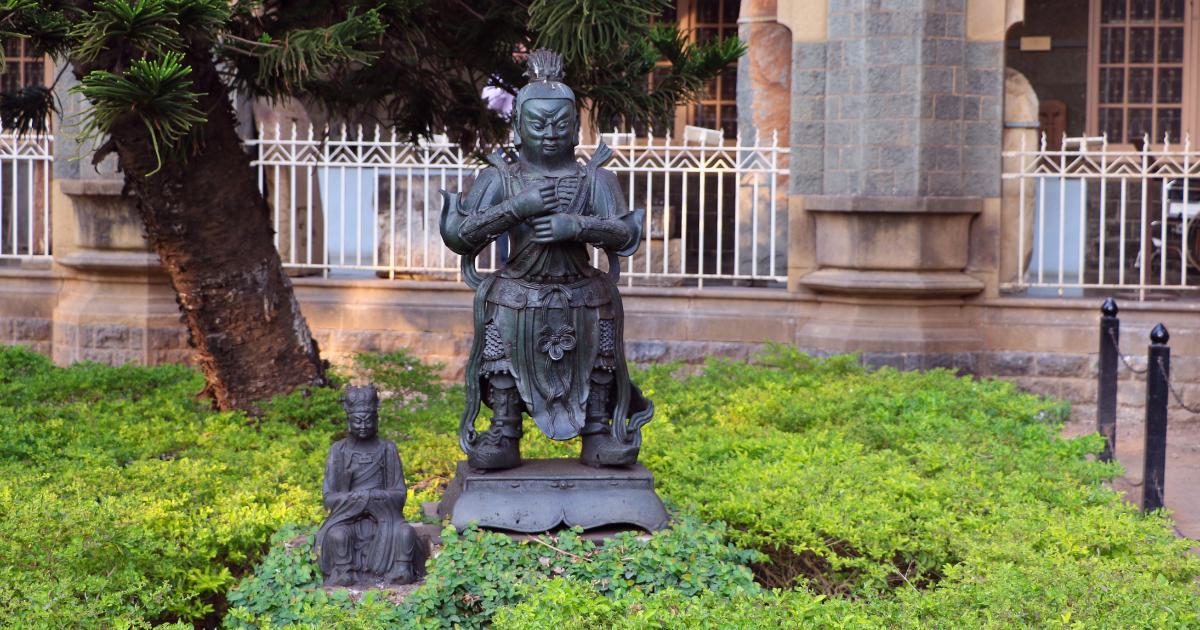
Bronze figures from the museum's East Asian collection displayed in the compound garden.
Visiting Mumbai with Remarkable East
Remarkable East features small group journeys through India, with the CSMVS in Mumbai often featured as part of a guided walk through the Kala Ghoda and Fort heritage districts. Our North India small group departures run with a maximum of 12 guests and are accompanied by expert local hosts who can guide visitors through the collections and the wider history of nineteenth and early twentieth century Bombay.
For longer trips, or to combine Mumbai with Rajasthan, Gujarat or Kerala, we can build a private journey around your interests. Contact our team to discuss an itinerary, or browse current India departures on our website.