
The History Of Vietnamese Iced Coffee
Vietnam is the world's second-largest coffee producer, yet the country's relationship with the bean is barely 170 years old. What began as a French colonial experiment in the mid-nineteenth century has grown into one of Southeast Asia's most recognisable food cultures, with ca phe sua da, the signature Vietnamese iced coffee, at its centre.
The story of the Vietnam iced coffee is one of adaptation. Each element of the drink, from the Robusta beans to the sweetened condensed milk to the small metal filter balanced on top of the glass, exists because of a specific set of circumstances in Vietnam's history. Understanding how those pieces came together makes the drink worth more than just its caffeine.
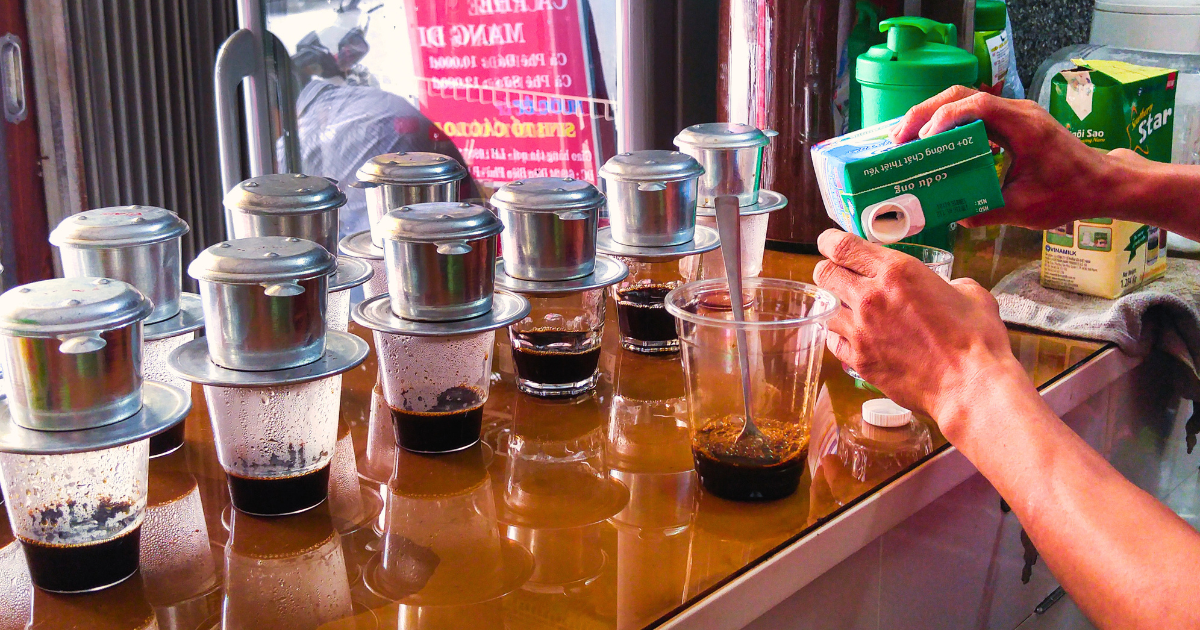
Each element of Vietnamese iced coffee, from the Robusta beans to the condensed milk to the phin filter, exists because of a set of circumstances in the country's history.
How coffee first arrived in Vietnam
Coffee was introduced to Vietnam in 1857 by a French Catholic priest during the colonial period. France had established Vietnam as part of French Indochina and saw potential in the region's tropical climate for growing new crops. What started as a single tree planted in the north would eventually give rise to one of the world's largest coffee industries, though it took over a century to get there.
That first planting was modest in scale. The priest brought a single Arabica tree to northern Vietnam with hopes of establishing a small coffee-growing venture. For several decades, production remained limited. Arabica requires specific altitude, temperature and rainfall conditions, and much of northern Vietnam's lowland terrain did not offer the right combination for the plant to thrive.
The first plantations in the Central Highlands
By the late nineteenth century, French colonists had identified the Central Highlands as far more suitable ground for coffee. The provinces of Dak Lak, Lam Dong and Gia Lai offered the elevation, volcanic soil and consistent rainfall that coffee plants needed to flourish.
Plantations began to take shape across the region, initially growing Arabica. These estates were managed primarily as export operations, with beans shipped back to Europe. A domestic coffee culture had not yet taken hold, but the foundations for one were being laid.
Colonial cafes in Hanoi and Saigon
Coffee drinking in Vietnam began in the cities rather than on the farms. French-style cafes opened in Hanoi and Saigon during the early twentieth century, modelled on the kind found in Paris. They quickly became popular social spaces, drawing both French residents and Vietnamese locals.
Over time, coffee spread into everyday Vietnamese life. Street vendors began brewing and selling it, gradually adapting the French style to local tastes and the ingredients available to them. The drink that took shape looked quite different from what was being served in Parisian cafes, and it was all the better for it.
How Doi Moi changed Vietnamese coffee forever
Vietnam's coffee industry spent most of the twentieth century in a holding pattern. The Vietnam War disrupted production across the Central Highlands, and after reunification in 1975 the new government collectivised agriculture, including coffee farms. Private enterprise was limited, output stayed low, and Vietnam was nowhere near being a serious player in the global coffee market. That all changed in 1986.
What the Doi Moi reforms actually did
Doi Moi was a series of economic reforms that shifted Vietnam towards a market-oriented economy. The changes allowed private land ownership and encouraged farmers to grow crops for export rather than solely for state-controlled distribution. Coffee was one of the first industries to benefit. Farmers in the Central Highlands began expanding their plantations and investing in production with a level of independence they had not previously had.
Vietnam becomes a global coffee power
The results came quickly. Throughout the late 1980s and 1990s, Vietnamese coffee output grew at a remarkable pace, driven largely by smallholder farms cultivating just one to five acres each. By the mid-1990s Vietnam had become one of the world's top coffee exporters, and today the country sits second only to Brazil in total production. It accounts for roughly 40% of the world's Robusta supply and around 20% of all global coffee exports.
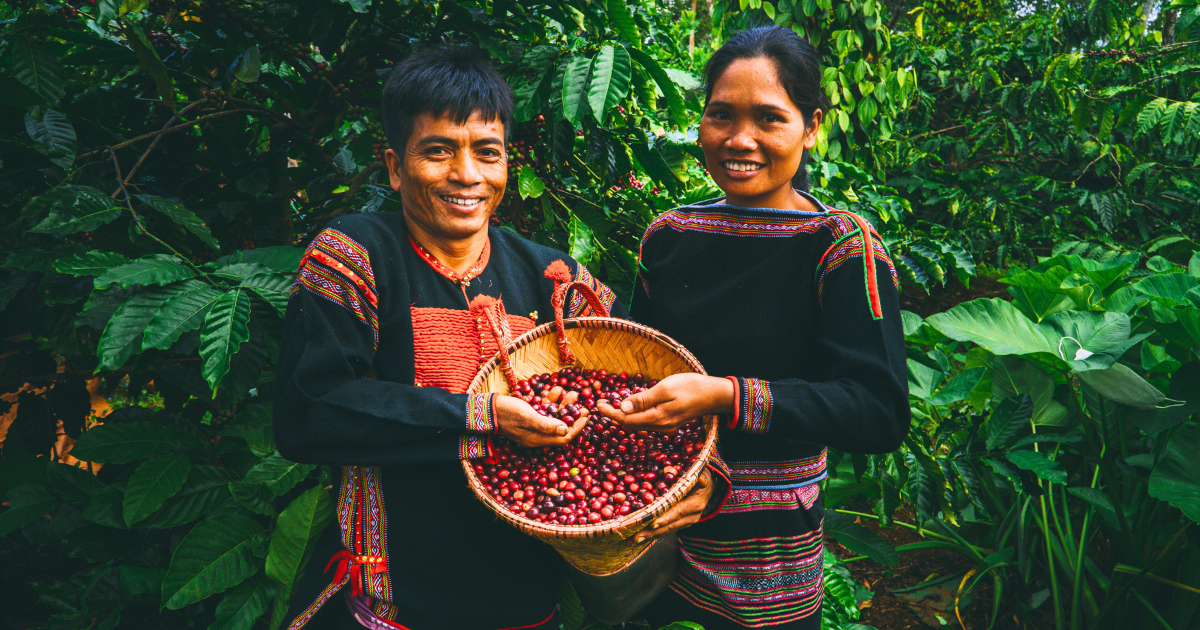
Vietnam's coffee boom was driven largely by smallholder farms cultivating just one to five acres each across the Central Highlands.
Which coffee bean is used in Vietnam?
Vietnam grows almost exclusively Robusta coffee, with the bean accounting for around 95% to 97% of all production in the country. This makes Vietnam the world's largest Robusta producer by a significant margin. Robusta has a stronger, more bitter flavour profile than Arabica, with earthy, nutty undertones and nearly double the caffeine content.
Vietnam does grow small amounts of Arabica in cooler, higher altitude regions, and interest in Vietnamese specialty coffee has been growing in recent years. But Robusta is still the bean behind nearly every cup of ca phe sua da served across the country.
What is in Vietnamese iced coffee?
Vietnam iced coffee is made from three core components: dark roast Robusta coffee, sweetened condensed milk and ice, brewed using a small single-serve metal filter called a phin. The drink is known in Vietnamese as ca phe sua da, which translates literally to coffee, milk, ice. What makes it distinctive is how few ingredients are involved and how much each one contributes to the final flavour.
Dark roast Robusta coffee
The coffee used in ca phe sua da is ground to a fine, sand-like consistency and roasted dark, often further than what is standard in Western coffee production. Some Vietnamese brands also roast their beans with a small amount of butter or flavourings like cocoa or vanilla, which adds a slight caramel richness to the brew.
The coffee that comes out of the phin is thick, syrupy and intensely concentrated, closer in strength to espresso than to a standard filter coffee, and deliberately so because it needs to hold its own against the sweetness of condensed milk and the dilution from ice.
Sweetened condensed milk
Condensed milk is arguably the ingredient that defines Vietnamese coffee. It was introduced to Vietnam by the French in the 1860s as a practical solution to a clear problem, fresh milk was almost impossible to come by.
Southeast Asia had no established dairy farming tradition, and the tropical climate meant that any fresh milk imported from Europe would spoil long before it arrived. Sweetened condensed milk, with its long shelf life and no need for refrigeration, filled the gap perfectly. It also happened to pair well with the strong, bitter flavour of Robusta, smoothing it out with a thick, caramel-like sweetness.
The phin filter
The phin is a small stainless steel or aluminium filter that sits directly on top of the drinking glass. It consists of four parts: a saucer-like plate that rests on the rim of the glass, a brewing chamber where the coffee grounds go, a press disc that sits on top of the grounds, and a lid. Hot water is poured in and the coffee drips slowly through into the glass below, usually taking around five to seven minutes.
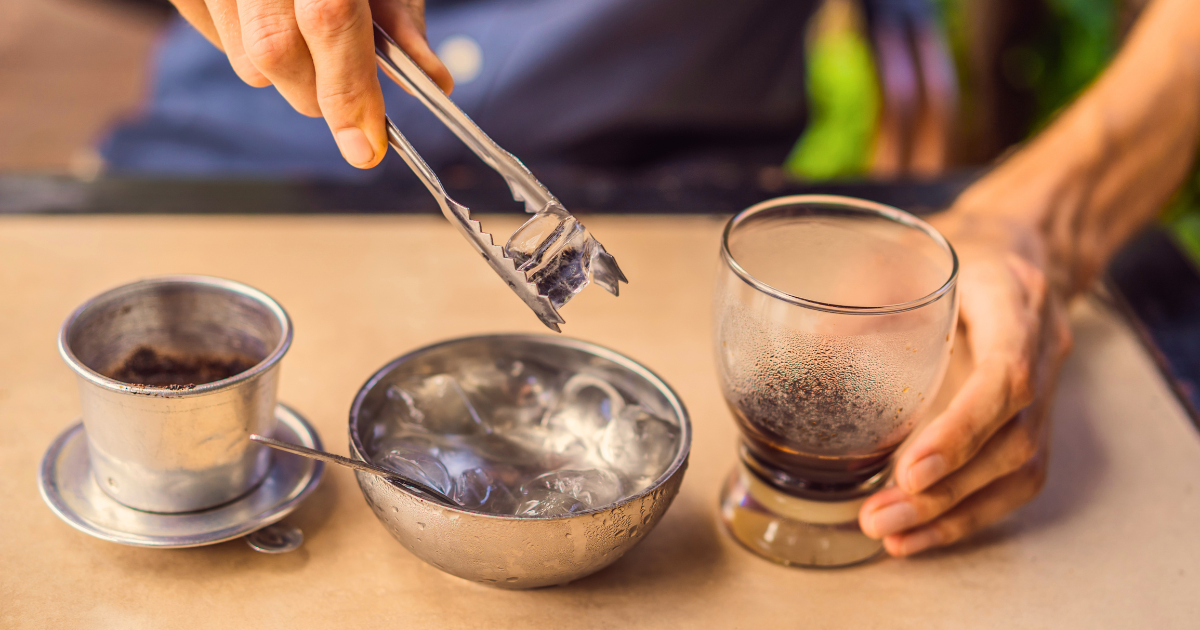
Vietnam iced coffee is made from three core components: dark roast Robusta coffee, sweetened condensed milk and ice, brewed using a phin filter.
Why is Vietnamese coffee so strong?
Vietnamese coffee gets its strength from a combination of the bean, the roast and the brewing method. Robusta contains nearly double the caffeine of Arabica, at roughly 2.7% compared to 1.5%. That alone makes for a more potent cup before anything else is factored in.
The dark roast concentrates the flavour further. And the phin's slow extraction pulls more from the grounds than a faster brewing method would. Each glass ends up small and concentrated, packed with more caffeine than its size suggests.
What catches most people off guard is how easy it is to drink. The condensed milk and ice smooth out the bitterness and make it taste lighter than it is, but the caffeine hit stays fully intact. For anyone used to milder Arabica-based coffees, the first glass of ca phe sua da can be a genuine surprise.
What Vietnamese coffee culture looks like on the ground
Coffee culture in Vietnam is built around slowing down. Unlike most Western countries where coffee is something people grab on the way to work, in Vietnam it is something you sit down for, often for longer than the drink itself takes to finish.
How the Vietnamese actually drink their coffee
Sometimes alone, sometimes with friends, and at any hour of the day. Morning, afternoon and evening are all equally valid times to order a coffee in Vietnam. The Vietnamese coffee recipe has barely changed in decades either. Walk into any cafe or street stall in Vietnam and the scene is the same. A phin filter sits on top of a glass, condensed milk lines the bottom, and everyone waits for the drip to finish.
Street stalls, plastic stools and complimentary tra da
Step outside the cafes and the same coffee is being served at street level for a fraction of the price, often less than a dollar a glass. These stalls are where much of Vietnam's coffee culture actually lives. You pull up a plastic stool, order a ca phe sua da, and almost always receive a complimentary glass of iced tea alongside it, known as tra da.
For travellers, these street-side stops are often the most memorable, and the easiest way to experience daily life as it actually happens.
Cafe life in Hanoi and Ho Chi Minh City
In Hanoi, this plays out in small, often hidden cafes tucked up narrow staircases or down quiet alleyways. People settle in for long stretches, watching the street while their phin drips, and there is rarely any pressure to leave.
Ho Chi Minh City moves faster, and its cafe scene reflects that. The spaces are bigger, louder and more varied, from pavement stalls to sleek modern bars to places like Saigon's Cafe Apartments, a converted 1960s apartment block where each unit has been turned into its own independent cafe. But the underlying habit is the same. Even in the busiest parts of the city, people still sit down for their coffee rather than taking it to go.
What other coffee drinks are popular in Vietnam?
Ca phe sua da may be the drink most travellers encounter first, but it is far from the only way Vietnamese people drink their coffee. Across the country, regional variations have developed over the decades, each shaped by local ingredients, local tastes and, in some cases, the need to work around whatever was available at the time.
Ca phe trung: Egg coffee in Hanoi
Egg coffee was born out of a milk shortage. In 1946, during the First Indochina War, fresh milk became nearly impossible to find in Hanoi. Nguyen Van Giang, a bartender at the Sofitel Legend Metropole Hotel, began experimenting with egg yolks as a substitute. He whisked them with condensed milk and sugar to create a thick, custard-like cream, then spooned it over strong black coffee. It tastes closer to a liquid tiramisu than a conventional coffee and remains a distinctly Hanoian experience.
Ca phe dua: Coconut coffee
Coconut coffee blends Vietnamese coffee with coconut milk, condensed milk and ice, usually whipped or blended together into something cold, thick and creamy. It is a more recent addition to the coffee scene and particularly popular in the south, where coconut is a common ingredient across the cuisine. The coconut softens the bitterness of the Robusta and adds a rich, slightly tropical sweetness that sits somewhere between a coffee and a dessert drink.
Ca phe muoi: Salt coffee from Hue
Salt coffee originated in 2010 at a small cafe in Hue run by a husband-and-wife team, Ho Thi Thanh Huong and Tran Nguyen Huu Phong. Their idea was simple but unusual: top a base of Vietnamese coffee and condensed milk with a layer of cream whisked with a pinch of salt. The salt does not make the drink taste savoury. Instead, it works the way it does in salted caramel, cutting through the bitterness of the coffee and lifting the sweetness of the milk.
Bac xiu: The Saigonese answer to a latte
Bac xiu is essentially the reverse of ca phe sua da. Where ca phe sua da is coffee with milk, bac xiu is milk with coffee. The name comes from Cantonese and translates roughly to "white and little," referring to the large proportion of condensed milk and the small amount of coffee added to it. The drink is pale, very sweet and mild, making it a popular choice for those who find regular Vietnamese coffee too strong. It is especially common in Ho Chi Minh City and has roots in the city's Cantonese-Vietnamese community.
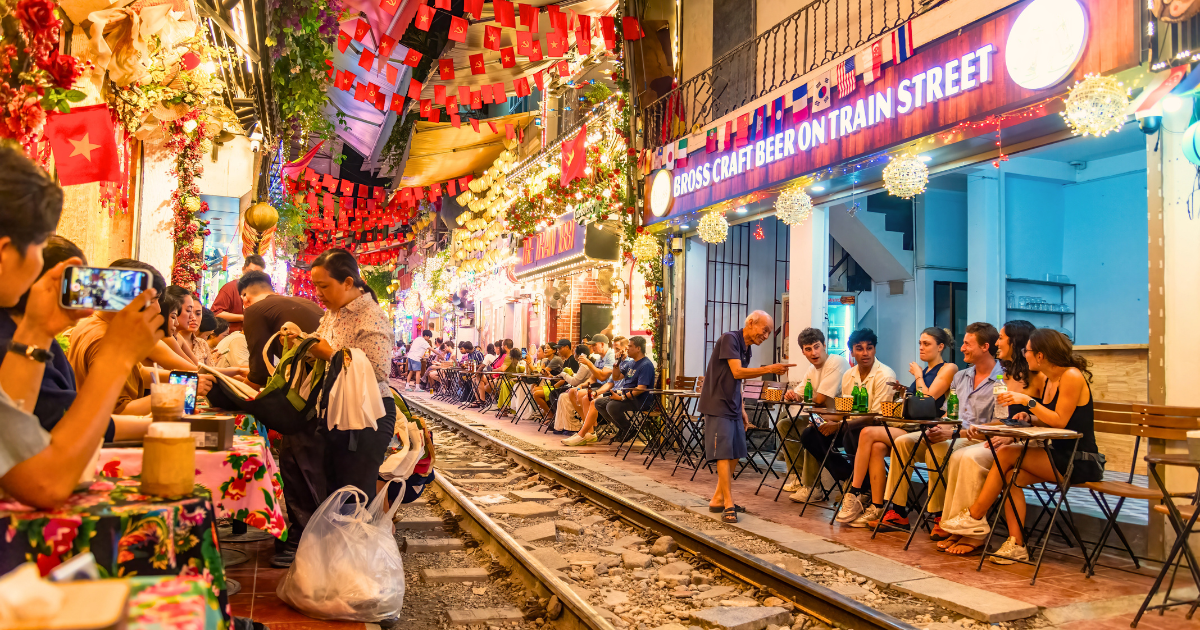
In Hanoi, cafes are often tucked into unexpected spaces, from narrow staircases and quiet alleyways to the railway tracks that run through the Old Quarter.
Experiencing Vietnamese coffee with Remarkable East
Vietnamese coffee is best understood in context. Watching a phin drip into a glass at a street-side stall in Hanoi's Old Quarter, or sitting on a low plastic stool in a Ho Chi Minh City alleyway with a glass of ca phe sua da and a complimentary iced tea, gives the drink a meaning that no recipe can replicate at home.
Remarkable East runs small group tours through Vietnam with a maximum of 12 guests per departure, led by expert local hosts who know where to find these kinds of everyday cultural moments. If you are planning a trip to Vietnam and want coffee culture to be part of the journey, get in touch with the Remarkable East team to explore upcoming departures.