
Inside Intramuros And The Historic Heart Of Manila
Manila, the capital of the Philippines, lies on the western coast of Luzon, where the Pasig River flows into Manila Bay. Long before the Spanish arrived in the 16th century, the city developedaround a riverside settlement that traded with other parts of Asia. Under Spanish rule, the settlement became the colonial capital, with defensive walls built around its churches, government buildings and homes. The area inside these walls became known as Intramuros, meaning “within the walls”.
Manila has since expanded far beyond those walls, with Intramuros now forming a small part of the modern capital. A guided walk through Intramuros takes in San Agustin Church, which survived the Second World War, and Casa Manila, a recreated colonial home furnished to show how wealthy families once lived. These buildings help explain what remains of old Manila and how parts of the district have been restored.
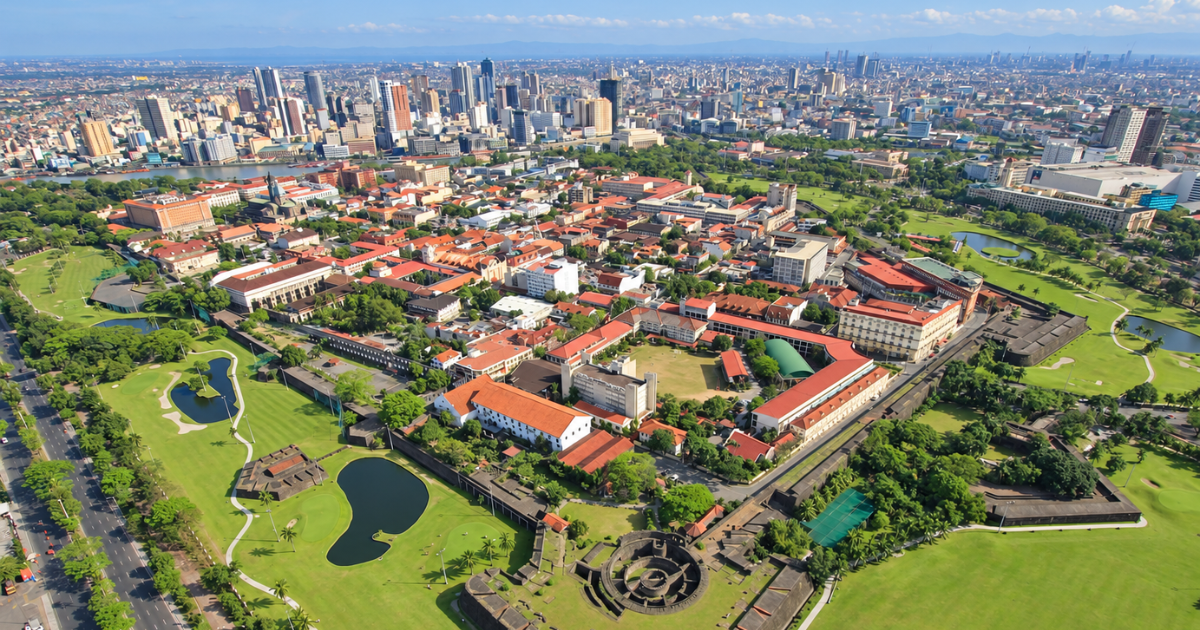
The defensive walls still mark the boundaries of Intramuros, while modern Manila extends far beyond the former colonial capital.
What is Intramuros known for?
Intramuros in Manila is known for its Spanish colonial fortifications and churches, with many of its best-known landmarks still enclosed by the city walls. Fort Santiago and the surrounding bastions once defended the capital, while churches stood close to the centres of government. Several former religious and military buildings now house museums exploring life under colonial rule.
Fort Santiago and the Rizal Shrine
Fort Santiago was built beside the Pasig River to defend the water route into Spanish Manila. A moat protected its inner grounds, where soldiers lived and prisoners were held. Visitors cross the moat by bridge to reach the main gateway. The gateway bears an image of Saint James, known in Spanish as Santiago, after whom the fort was named.
Among its prisoners was José Rizal, whose novels criticised abuses under Spanish rule. He spent his final weeks here before his execution in 1896. The barracks where he was confined were later damaged during the Second World War, but the wing containing his cell was reconstructed. It now houses the Rizal Shrine, with museum displays devoted to his life and writings.
San Agustin Church and Museum
San Agustin Church was completed in 1607 and is the oldest surviving stone church in the Philippines. It is one of four churches included in the UNESCO-listed Baroque Churches of the Philippines. Inside, much of the decoration is painted to resemble carved architectural details. Italian artists used shading and perspective to give the ceiling this three-dimensional appearance, a technique known as trompe l’oeil.
The wooden choir stalls above the entrance are decorated with carvings and inlays. These seats were used by the Augustinian friars, who served the church and lived in the adjoining monastery. Their former living quarters now house the museum, where galleries display religious paintings and carved sacred figures made for Catholic worship during the colonial period.
Casa Manila and Plaza San Luis
Casa Manila is a house museum within Plaza San Luis, across the street from San Agustin Church. Built in the 1980s, it recreates an affluent home from the late Spanish colonial period, with a façade modelled on a 19th-century house in Binondo. A stone-paved passage leads into a courtyard, where stairs lead up to the furnished rooms.
A waiting area beside the office shows how business callers would have been received, while reception rooms display European furniture and Chinese ceramics. These furnishings reflect the taste for imported goods among wealthy families. The house also demonstrates how homes accommodated Manila’s heat, with wooden window louvres reducing direct sunlight and carved openings above doors allowing air to circulate.
Baluarte de San Diego and the city walls
Baluarte de San Diego protected the side of Intramuros facing Manila Bay. As a bastion, it projected beyond the adjoining walls so defenders could watch the approaches and fire along the city’s perimeter. Its angular shape surrounds the circular remains of an earlier tower, whose base was incorporated into the bastion after cracks forced the removal of its upper section.
The tower’s remains were buried during American rule, which helped protect them from the destruction of the Second World War. Excavations uncovered the circular structure in 1979, and restoration of the surrounding bastion followed. Visitors can now view the exposed stone foundations within an archaeological park, with gardens occupying ground once used for a foundry and soldiers’ barracks.
Manila Cathedral and Plaza de Roma
Manila Cathedral faces Plaza de Roma, where the Spanish authorities established the main institutions of colonial government. The governor’s palace and the Ayuntamiento, or city hall, also faced the square. Their arrangement brought religious and government officials into the same small area, with the plaza serving as the public space between them.
Although the cathedral still occupies this historic site, the building has changed repeatedly as fires and earthquakes destroyed earlier churches. Its most recent reconstruction followed the Second World War, and the present cathedral was completed in 1958. Visitors approaching the entrance can follow that history through the bronze door panels, which depict earlier buildings and the disasters that led to their replacement.
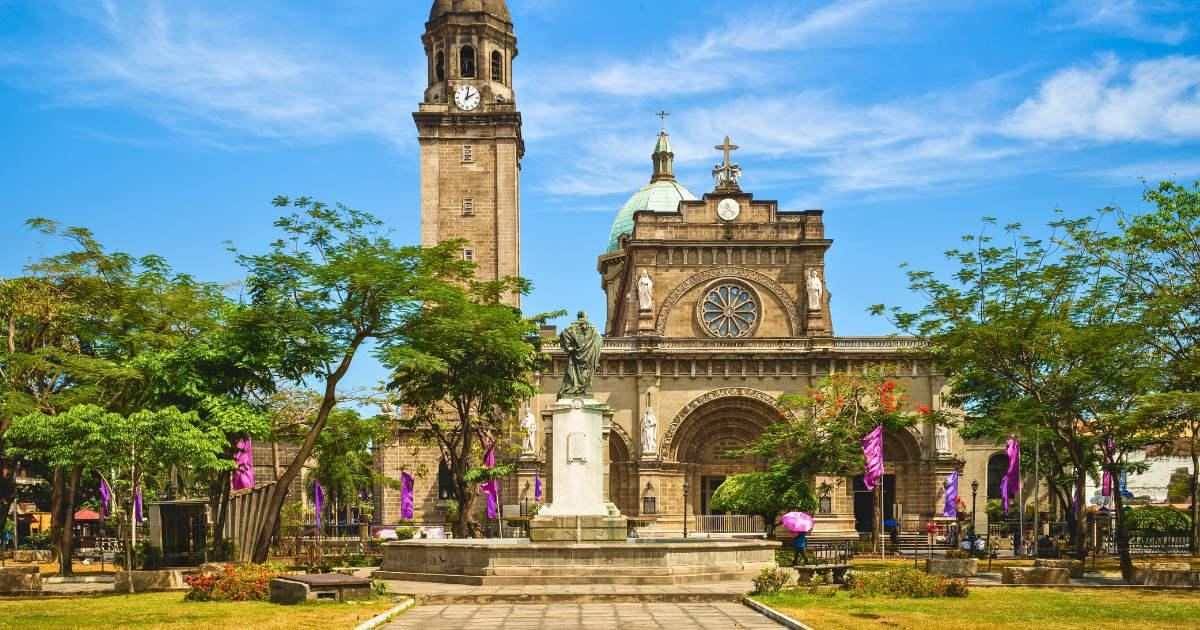
Manila Cathedral stands on Plaza de Roma, the historic square where religious and government institutions were concentrated during Spanish rule.
The history behind Manila’s walled city
For much of the Spanish colonial period, the walled city was simply known as Manila. The name Intramuros became more common as the city expanded, distinguishing the older district from the neighbourhoods beyond its walls. Accounts of the earlier settlement often use Maynila, which remains the Filipino name for the city today. Manila is the Spanish spelling retained in English.
Maynila before Spanish rule
Maynila stood on the south bank of the Pasig River, with Tondo on the opposite side. Both settlements belonged to a network of trading communities around Manila Bay, with connections reaching China and Brunei. Ships arriving from overseas could exchange goods here, while the river provided access to communities further inland.
The settlement had its own rulers, including Rajah Sulayman and Rajah Matanda, whose family had ties to Brunei. Near the river mouth, a fortification of timber and earth protected the community and its trading activities. The fortification stood on the site of present-day Fort Santiago, where the Spanish later established their own defences after taking control of Maynila.
The rise of the Spanish colonial capital
In 1571, Miguel López de Legazpi established the Spanish colonial capital on the site of Maynila. Streets were laid out in a grid around the main square, where the cathedral and government buildings became the centre of the new city. As the settlement developed, stone walls replaced earlier defences and were extended and strengthened over successive generations.
Under Spanish rule, Manila’s trading connections expanded across the Pacific.. Galleons carried goods such as silk from Manila to Acapulco in present-day Mexico, linking Asian merchants with markets in Spain’s American colonies. The trade continued until 1815, bringing overseas goods and commercial wealth to the port while Intramuros remained the centre of the colonial government.
Wartime destruction and restoration
Spanish rule ended in 1898, followed by American colonial administration and then Japanese occupation during the Second World War. In 1945, American forces fought to retake Manila from Japanese troops, with Intramuros among the areas devastated. Around 100,000 civilians died across the city through Japanese atrocities and the fighting, including American bombardment. The Memorare Manila 1945 monument in Intramuros commemorates these civilian victims.
Restoration began with individual landmarks, including Fort Santiago in the years after the war. In 1979, the Intramuros Administration was established to oversee restoration and development across the district. Its work has included restoring the fortifications and overseeing construction in keeping with Philippine-Spanish architecture. Buildings such as Casa Manila were created as part of this work to show how wealthy families lived under Spanish rule.
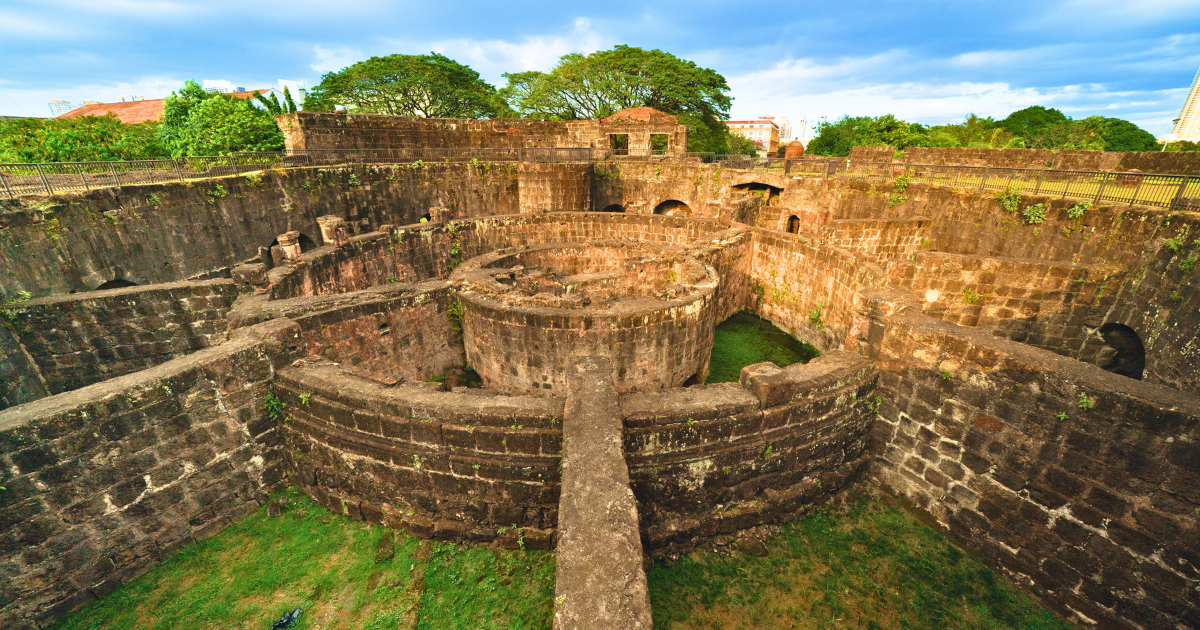
Baluarte de San Diego incorporates the remains of an earlier circular defensive tower into the fortifications that once protected Intramuros from the Manila Bay side.
What can travellers do inside Intramuros?
Many of Intramuros’ main sights are close enough to visit on foot, with museums and places to eat along the way. Travellers can walk between Fort Santiago and San Agustin Church or join a guided bicycle tour with stops at historic landmarks. Allowing time between landmarks leaves room to explore the galleries or stop for lunch.
Follow a walking route through the historic streets
General Luna Street connects several of the district’s main landmarks, making it a straightforward route through historic Manila. Starting at Fort Santiago, travellers can walk towards Plaza de Roma and Manila Cathedral, then continue along General Luna to San Agustin Church. Casa Manila stands across the street, so both can be visited without retracing the route.
From this central group of buildings, the walk can continue towards Baluarte de San Diego and the southern walls. The route leaves room to pause in the squares and courtyards between stops. Museum visits will take longer than the walks connecting them, so choosing which interiors to explore helps keep the day manageable.
Explore Intramuros by bamboo bicycle
Guided bamboo bicycle tours offer a way to explore Intramuros on bikes with handmade bamboo frames. Riders follow a guide through the streets, stopping to hear the stories behind the buildings and fortifications. These stops break up the cycling with time to look around, so the ride becomes an introduction to the district’s history.
Routes and durations vary, with some tours taking in landmarks such as Manila Cathedral and Fort Santiago. Before booking, check the meeting point and whether the itinerary includes entry to attractions or stops outside them. This helps travellers decide which museums or churches to visit separately before or after the ride.
Visit museums to understand life in old Manila
The district’s museums cover different subjects, so a visit can follow a particular interest. Centro de Turismo Intramuros introduces the history of the walled city on the former site of San Ignacio Church. Next door, Museo de Intramuros focuses on religious art, with galleries displaying objects associated with the spread and practice of Catholicism in the Philippines.
Bahay Tsinoy explores the history of the Chinese community in the Philippines, beginning with trade and contact before Spanish colonisation. Life-size dioramas and historical objects accompany the account of Chinese settlement and its influence on Philippine life. The museum broadens the story beyond the colonial authorities to include the communities involved in the city’s trade and everyday work.
Try Filipino food in a courtyard restaurant
Ilustrado, on Cabildo Street at the corner of Recoletos Street, serves Filipino and Spanish dishes in a setting with an indoor dining room and garden courtyard. Its location within the walls allows travellers to stop for a seated lunch between visits, with outdoor tables offering a break from walking through the surrounding streets.
House specialities include adobong bagnet with crab fat, combining crisp fried pork belly with a rich sauce. The menu also features paella, reflecting the Spanish influence on the restaurant’s cooking. For travellers interested in trying several dishes, a shared meal offers more variety than ordering a separate main course for each person.
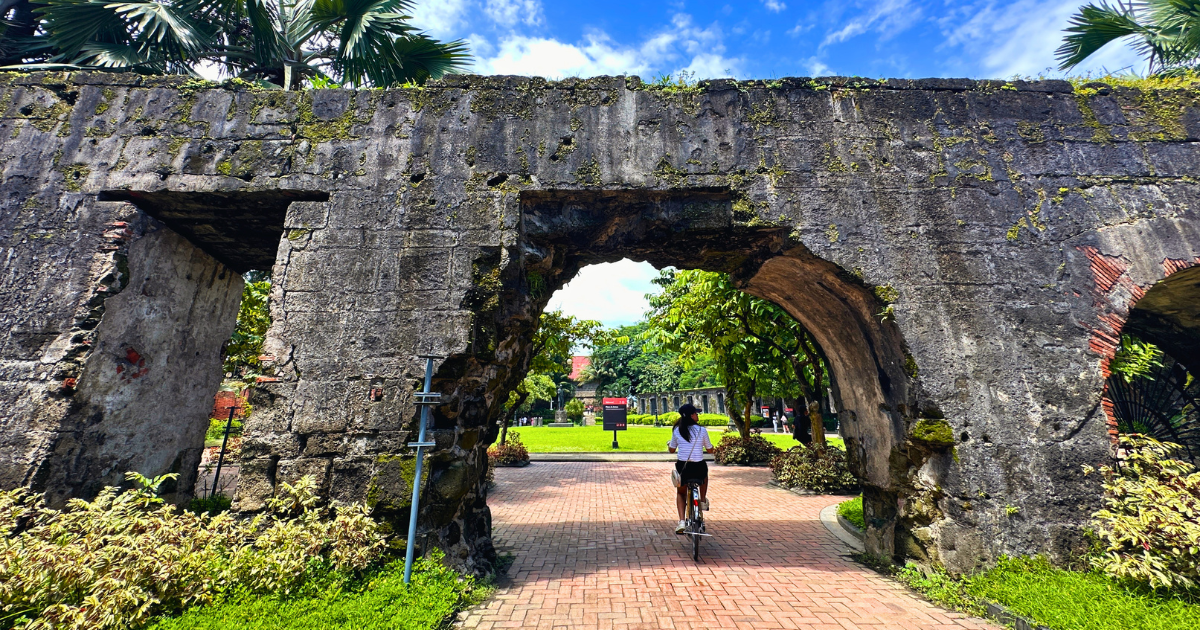
Cycling offers another way to move between Intramuros’ historic streets, fortifications and landmarks while exploring the walled district.
How to make the most of a day in Intramuros
A visit to Intramuros involves walking between separate attractions, each with its own entrance and visiting arrangements. Planning around a few places of interest makes it easier to choose a drop-off point and decide whether to explore independently or join a tour. Museum visits account for much of the time spent here, even when the buildings are only a short walk apart.
How do travellers get to Intramuros?
A private driver, taxi or Grab car can bring travellers directly from their accommodation to the district. Fort Santiago is a useful starting point for a route that continues past Manila Cathedral to San Agustin Church and Casa Manila. Travellers focusing on the churches and museums around Plaza San Luis can instead arrange to arrive near San Agustin Church.
For those staying in Makati or Bonifacio Global City, the journey involves travelling across Metro Manila, where traffic can substantially lengthen the drive. For a booked tour, give the driver the exact meeting point and arrange to arrive before the scheduled start. With a private driver, collection can be arranged near the final stop, allowing a walk from Fort Santiago to finish around San Agustin rather than doubling back.
Can travellers explore Intramuros without a guide?
Travellers can walk through Intramuros independently and choose which attractions to enter along the way. This works particularly well for those who want to spend longer reading museum displays or looking around a church. The official Intramuros web app includes suggested self-guided tours and information about individual sites, helping visitors connect the buildings they pass with the district’s history.
For a first visit, a guide can explain how events at different landmarks fit together, including how Spanish rule shaped the district and how the Second World War changed it. The Intramuros Administration lists accredited guides offering general walks and tours focused on particular periods. Before booking, check which buildings the group enters, whether admission is included and how much time is allowed at each stop.
How long does it take to explore Intramuros?
Allow roughly half a day for Fort Santiago, the cathedral area and a visit to Casa Manila. Within that plan, set aside at least an hour for the fort’s grounds and Rizal Shrine, then leave time for the walk through Plaza de Roma towards San Agustin. Entering museums, reading displays and stopping for refreshments will extend the visit beyond the walking time alone.
Adding San Agustin’s museum and Bahay Tsinoy can turn this into a full day, particularly with lunch between visits. For a shorter introduction, some guided walks cover the main landmarks in two to 2.5 hours. Their schedules leave less freedom to linger, so travellers keen on a particular museum may prefer to return after the tour and explore it independently.
What to know before visiting Intramuros
Exploring Intramuros involves walking outdoors between attractions, with stops inside churches and museums along the way. The weather will affect how comfortable those walks are, while museum opening hours can determine the order of visits. Checking both before setting out helps with choosing a starting time and deciding which places to visit first.
When is the best time to visit Intramuros?
December to February generally brings cooler, drier weather, making this a comfortable period for exploring on foot. The dry season continues through May, though temperatures rise from March onwards. During these hotter months, starting early allows more time outdoors before the midday heat. Rain is more frequent from June to November, so outdoor plans may need to change around showers.
Late afternoon is another option for walking, but it is worth visiting museums first, before they close. Casa Manila admits its last visitors at 5:00pm and closes at 6:00pm, while Fort Santiago stays open into the evening. For a visit that includes several museums, plan your visit between Tuesday to Sunday, as both Casa Manila and Museo de Intramuros close on Mondays.
Is Intramuros free to enter?
Visitors can walk through the public streets and squares of Intramuros without paying a general admission fee. Individual attractions charge separately, so the cost depends on which places travellers enter along the way. Fort Santiago and Casa Manila each charge PHP 75 for regular admission, approximately $2 AUD per site.
Some museums also offer free access to selected galleries. At Centro de Turismo Intramuros, visitors can explore the ground-floor museum for free, while the mezzanine exhibits and neighbouring Museo de Intramuros require a ticket. Before buying admission separately, check whether a booked guided tour already covers entry to those attractions.
What should visitors wear and bring?
Light, breathable clothing suits Manila’s heat, with shoulders and knees covered for church visits. Loose trousers or a longer skirt paired with a sleeved top can work for both walking and entering places of worship. A light shirt or shawl provides extra coverage when needed, and hats should be removed inside churches to show respect.
Walking also involves uneven paving and stone steps, so choose comfortable shoes with good grip, particularly after rain. Carry a compact umbrella for showers or shade along exposed streets, and apply sunscreen before setting out. Bring drinking water too, especially when spending longer outdoors exploring Fort Santiago’s grounds or walking along the city walls.
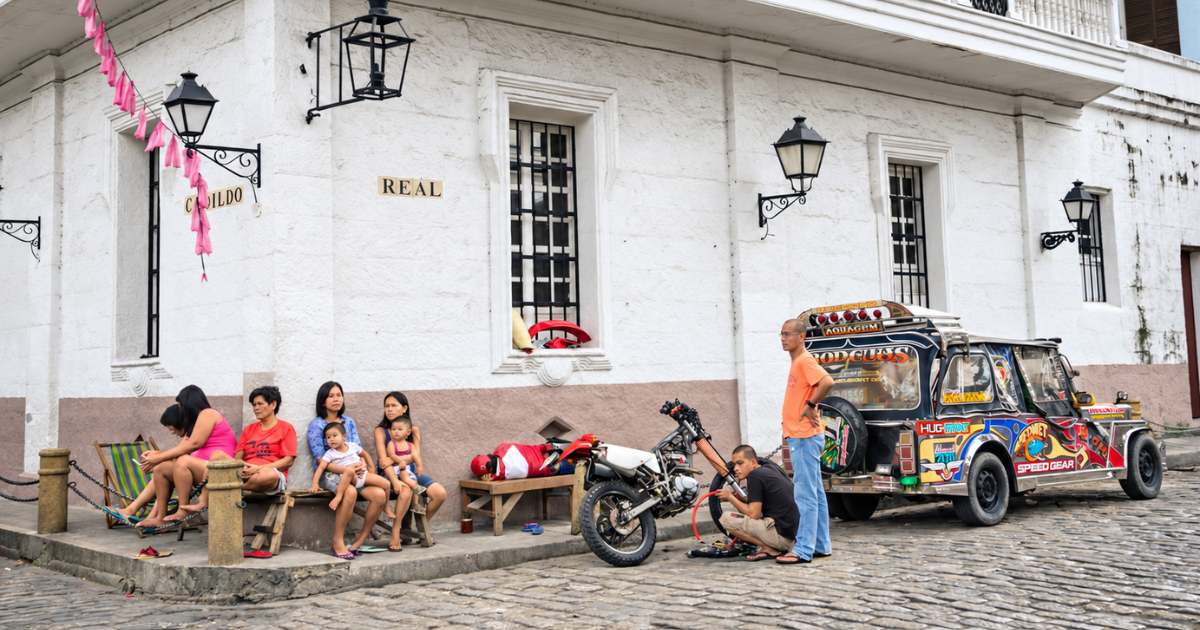
Walking between Intramuros’ landmarks brings travellers through streets such as Real and Cabildo, where everyday neighbourhood life forms part of the visit.
Explore Manila with Remarkable East
Remarkable East specialises in small group tours across Asia, with a maximum of 12 guests on each departure. Our Philippines Explorer Tour includes a guided walk through Intramuros as part of a 13-day journey from Manila through the islands of the Visayas. Contact our team to discuss the itinerary and upcoming departures.