
What To Know Before Visiting Sacred Temples In Thailand
Thailand is home to roughly 34,000 Buddhist temples, known locally as wats, and they are part of nearly every aspect of daily life. Over 90% of the Thai population practises Theravada Buddhism, the oldest surviving branch of Buddhism, and temples function as far more than architectural landmarks. They are places of worship, community gathering, education and merit-making, often with monks in residence and local families visiting throughout the day.
Temples are open to visitors, but because they are active religious sites, there are some expectations for how to dress and behave. These guidelines show the same modesty and respect that Thai Buddhists practice.
If you’re planning to visit temples in Thailand, taking a bit of time to learn about the dress code and basic etiquette will help your visit go smoothly.
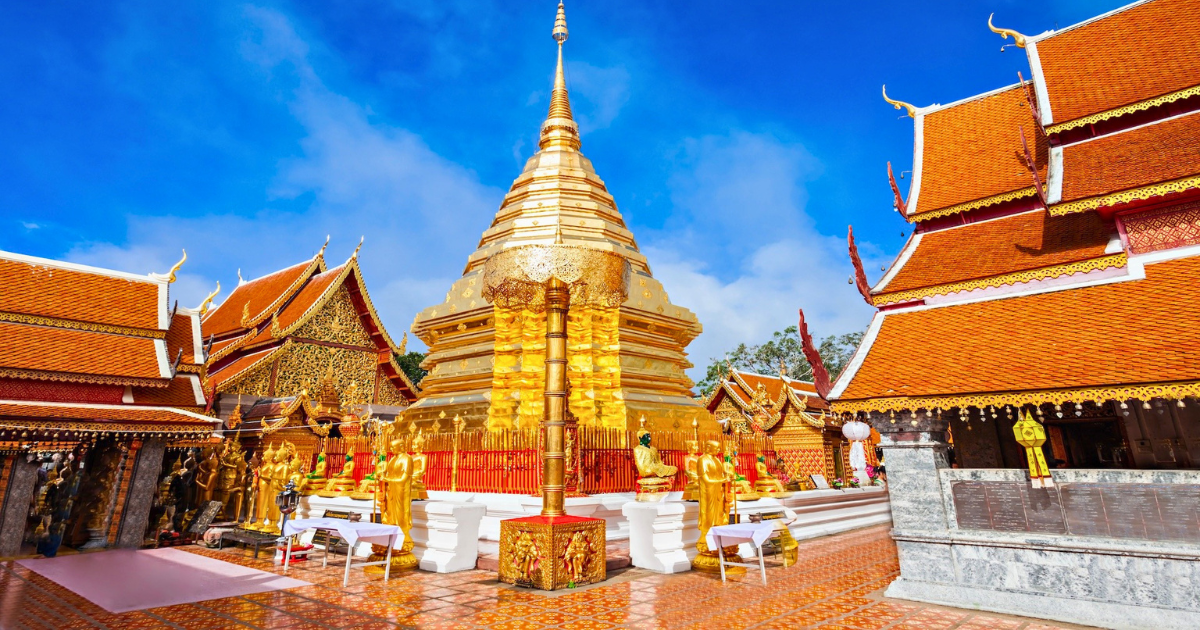
Wat Phra That Doi Suthep in Chiang Mai, one of northern Thailand's most visited royal temples, where dress code enforcement is consistent at the entrance.
Why do temple dress codes exist in Thailand?
Temple dress codes are based on Buddhist teachings that value modesty. Clothes that show too much skin are seen as inappropriate in places of worship. In Thai Buddhist culture, people are expected to dress in a way that doesn’t attract attention, especially around monks and sacred images.
This rule applies to everyone, including Thai locals. It’s normal to see Thai families visiting a wat wearing long pants or skirts and shirts with sleeves, even when it’s hot outside.
At larger temples, particularly those in Bangkok and Chiang Mai that receive large numbers of international visitors, the rules are clearly signposted at the entrance. Smaller rural temples may not have signs at all, but the same expectations apply. Awareness of the Thailand temple dress code before arriving tends to make the whole visit feel more comfortable and welcome.
Understanding the different types of Thai temples
Not all Thai temples operate in the same way, and the level of formality can vary depending on the type of wat being visited. Understanding the general categories makes it easier to prepare for the dress code, the atmosphere and how the visit will feel.
Royal and historic temples
Thailand's most visited temples are the royal wats, which have historically received patronage from the monarchy. Wat Phra Kaew in Bangkok, which houses the Emerald Buddha, is the most prominent example and holds a particularly strict dress code.
Wat Pho and Wat Arun, in Bangkok, also fall into this category. These temples are well-staffed, heavily visited and they enforce clothing rules at the gate. Visitors who do not meet the dress code are usually asked to borrow or rent a covering before entering.
City and community temples
Most Thai cities and towns have several neighbourhood wats that serve as centres of daily religious life. These are where locals go to make merit, attend ceremonies and consult with monks.
Community temples are generally less formal than royal temples, but the same expectations around modest dress apply. Because fewer tourists visit these sites, there may be no signage in English, and staff are less accustomed to managing visitors who are unfamiliar with the customs.
Forest and meditation temples
Forest monasteries, known as wat pa, are found in more rural and wooded parts of the country, particularly in the northeast. They are quieter, more austere and focused on meditation practice.
The atmosphere in meditation temples is noticeably more subdued than at a city wat, and visitors are expected to dress and behave accordingly. Talking is often kept to a minimum, and the dress code, while rarely enforced by staff, is taken seriously by the monks and practitioners who live there.
What to wear to a Thai temple?
The simplest way to dress appropriately for a Thai temple is to wear a sleeved top that covers the shoulders, paired with loose trousers or a skirt that falls below the knee. This applies to everyone regardless of gender, and getting it right makes the whole visit feel easier and more relaxed.
Lightweight fabrics like cotton and linen are ideal for the climate, and many travellers keep a scarf or shawl in their daypack as a quick backup for bare shoulders.
Do I need to cover my arms in Thai temples?
Short sleeves are perfectly fine at most temples. The main thing is that shoulders are covered, so a standard t-shirt does the job without any issue. Sleeveless tops and spaghetti straps are where it gets tricky. At a few of the stricter royal temples, such as Wat Phra Kaew, some visitors have been asked to cover their arms more fully, though this is the exception rather than the norm.
Are leggings allowed in Thai temples?
This one depends on the temple. Leggings that are thick, dark and opaque will generally be fine at most city and community wats. At royal and heavily touristed temples, however, they are sometimes considered too form-fitting or sheer. Loose-fitting trousers or a long skirt are the safer option. If leggings are the only option available, pairing them with a longer top that covers the thighs can help.
Can I wear sandals to a temple in Thailand?
Footwear tends to be much less of a concern than clothing, because shoes come off before entering any temple building. Open-toed sandals, thongs and slip-on shoes are all perfectly fine in temple grounds. Footwear that is easy to take off and put back on is actually ideal, since visitors often need to remove shoes several times over the course of a single visit.
What fabrics and colours are allowed in the temple?
There are no strict rules around fabric, but breathable materials like cotton and linen are the most practical, given Thailand's climate. Synthetic fabrics that trap heat can make a long temple visit uncomfortable, especially during the hot season between March and May.
As for colour, visitors should avoid wearing all black, which is associated with funerals in Thai culture, and all white, which is worn during certain religious observances and periods of mourning. Neutral and muted tones are the most appropriate.
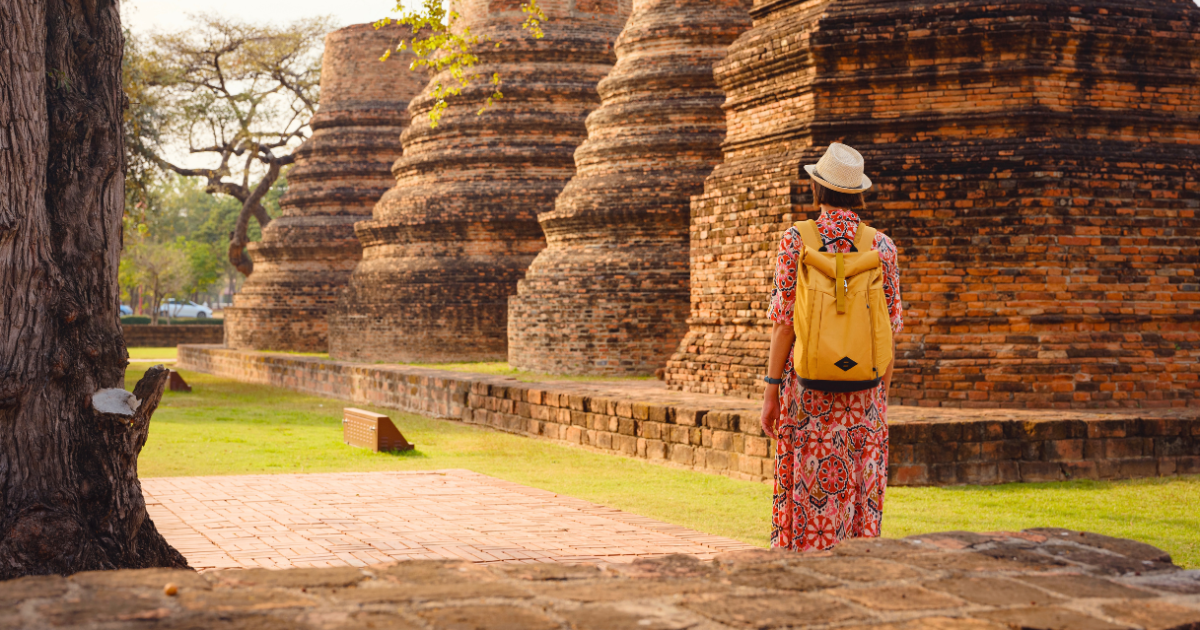
Loose, lightweight clothing that covers the shoulders and falls below the knee is the simplest way to dress appropriately for any Thai temple.
What happens if you arrive underdressed?
At larger and more touristed wats, staff at the entrance will offer a sarong, shawl or loose trousers to borrow or rent for a small fee. At Wat Phra Kaew, for example, there is a dedicated clothing station near the entrance for this purpose.
At smaller community or rural temples, there may not be a formal system in place. In these cases, visitors who are dressed inappropriately may simply be asked not to enter the main prayer hall. Thai people are generally gracious about it, and no one is likely to be made to feel uncomfortable.
The easiest way to avoid the situation altogether is to carry a light covering in a daypack. A cotton sarong or large scarf weighs next to nothing and folds flat, and can be wrapped quickly over shorts or bare shoulders before walking in.
What is the temple etiquette in Thailand?
Dressing appropriately is the most visible part of temple etiquette, but there are a few other customs worth being familiar with. Most of them are simple and easy to follow, and Thai people are generally appreciative when visitors make the effort.
Removing shoes before entering
Shoes are removed before entering any temple building, including the main prayer hall, smaller chapels and any structure that contains a Buddha image. There will usually be a clear area near the doorway where other shoes are lined up, which makes it easy to know when to take them off. Slip-on shoes or sandals make this much simpler, especially at temples where visitors move between several buildings in one visit.
Sitting and positioning your feet
When sitting inside a temple, the feet should be tucked away so that they do not point toward the Buddha image or any monks present. In Thai culture, the feet are considered the lowest part of the body, and pointing them at something sacred is seen as disrespectful. The easiest position is to sit with legs folded to one side, which is what most Thai visitors do. Sitting cross-legged also works well.
Interacting with monks and sacred objects
Monks are treated with a high level of respect in Thai society, and there are a few customs to be aware of during any interaction. Women should avoid making physical contact with a monk, and it is polite to leave a comfortable gap when passing one in a narrow space.
When offering something to a monk, it is placed on a cloth or tray rather than handed directly. Visitors of any gender should try to position themselves lower than a monk when speaking to one, and avoid standing over a seated monk.
Taking photos inside the temple grounds
Photography is welcome in most temple grounds, and many wats are wonderfully photogenic. Some temples do not allow photos near the principal Buddha image inside the main prayer hall, so a quick look for signage before reaching for a camera is a good habit. When monks or worshippers are praying, keeping a respectful distance rather than photographing up close goes a long way.
Making offerings and donations
Many temples have areas where visitors can make small donations or purchase offerings such as lotus flowers, incense and candles. This is entirely optional, but it is a welcomed gesture and a meaningful part of the temple experience. Donation boxes are usually found near the entrance or beside the main Buddha image. There is no expected amount, and even a small contribution is appreciated.
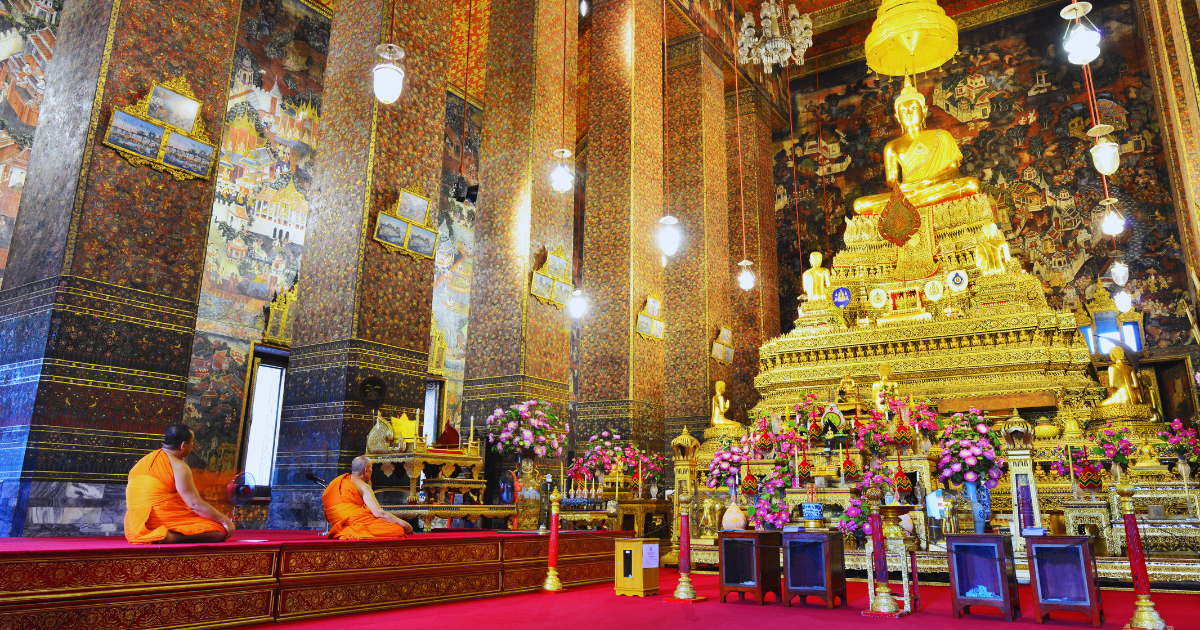
Temples are active places of worship where monks pray and study throughout the day, which is why modest dress and quiet behaviour are expected of all visitors.
When to visit and what to expect on arrival
Most Thai temples are open daily from around 6:00am to 6:00pm, though the main prayer hall may keep slightly shorter hours. Early mornings are a good time to visit, as temples are cooler, quieter and often at their most atmospheric with monks completing their morning routines. Late afternoons can also be pleasant, with softer light and fewer visitors.
Temple grounds are generally free to enter, though some of the more well-known wats charge a small admission fee for foreign visitors. Wat Pho and Wat Arun in Bangkok, for example, both have entry fees that go toward temple maintenance. Tickets are purchased at the gate, and the process is quick and straightforward.
On arrival, there is usually a clear path from the entrance toward the main buildings. Signage at larger temples is often in both Thai and English, and staff or volunteers are normally nearby to point visitors in the right direction.
At smaller or rural temples, the layout may be less obvious, but the main prayer hall is typically the largest and most prominent building in the compound. Taking a moment to look around before walking in helps with getting oriented and spotting any dress code signage near the entrance.
Visiting during ceremonies and Buddhist holidays
Most temples remain open to visitors during ceremonies and Buddhist holidays, and being present during one can be a memorable part of a trip. The key is to be a little more mindful than usual. Ceremonies are religious events, and the atmosphere inside the temple will be quieter and more focused than on a regular day.
On major Buddhist holidays such as Makha Bucha, Visakha Bucha and Asalha Bucha, temples are busier than usual with Thai worshippers. These dates follow the lunar calendar and shift each year, so checking ahead of time is helpful when planning a visit. Many temples hold candlelit processions in the evening on these days, and visitors are often welcome to observe or join in respectfully.
During an active ceremony, it is best to enter quietly and sit toward the back of the hall rather than walking through the middle. Keeping voices low and phones on silent shows consideration for those who are there to pray. If the temple feels particularly full or a private ceremony appears to be underway, stepping back and returning a little later is always a comfortable option.
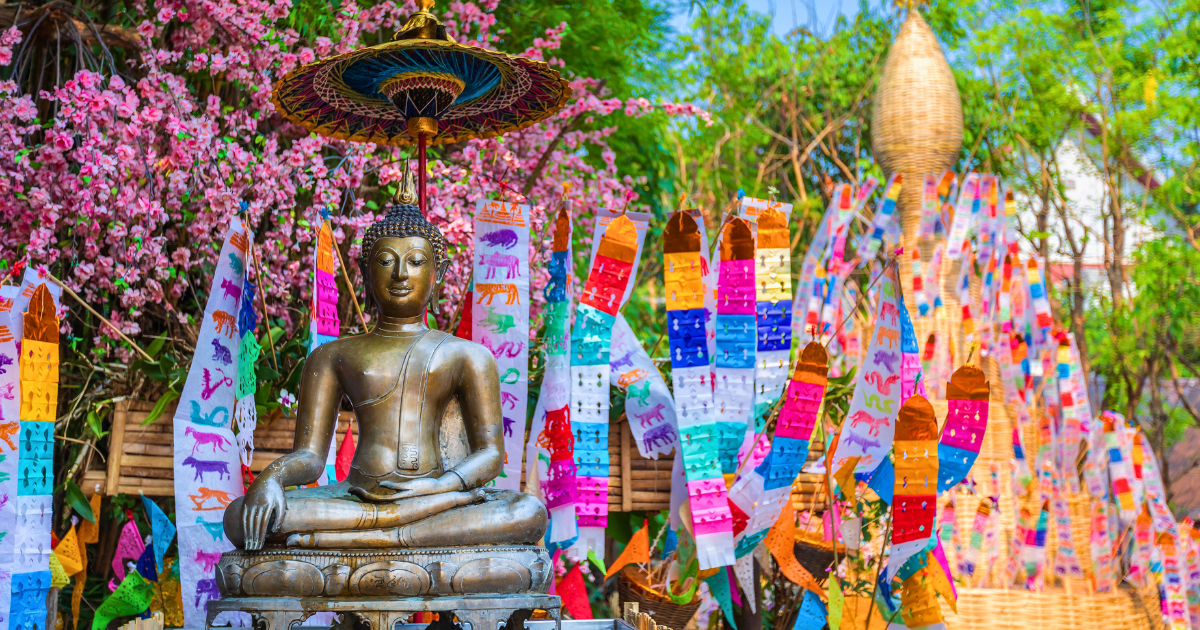
During Buddhist holidays, temples fill with colourful offerings and prayer flags, and the atmosphere is noticeably more ceremonial than on a regular day.
Visiting Thai temples with Remarkable East
Thai temples are among the most culturally rich places to visit in the country, and spending time inside them offers a genuine window into how Buddhism shapes everyday life in Thailand. With a little preparation around the dress code and basic etiquette, temple visits become one of the most rewarding parts of any trip.
Remarkable East small group tours, with a maximum of 12 guests per departure, explore Thailand through a wellness retreat that goes beyond the usual highlights. Each trip is led by an expert host who brings context and depth to every temple visit, from the well-known royal wats to quieter monasteries off the main trail.