
An Introduction To Japanese Onsen Culture
Japan sits on one of the most geologically active stretches of the Pacific Ring of Fire, where four tectonic plates meet beneath the archipelago. The country contains more than 100 active volcanoes, with roughly 27,000 hot spring sources spread across its four main islands. These waters surface in snowbound valleys in Hokkaido, in coastal towns across Kyushu and in the mountains of central Honshu, and they have done so for as long as people have lived on the islands.
Bathing in these waters has been part of Japanese daily life for well over a thousand years. It remains a ritual in most households, and travelling to a hot spring for longer soak is one of the country's most established forms of leisure. The onsen is the most recognisable form of this tradition, and one that comes with its own clear set of customs.
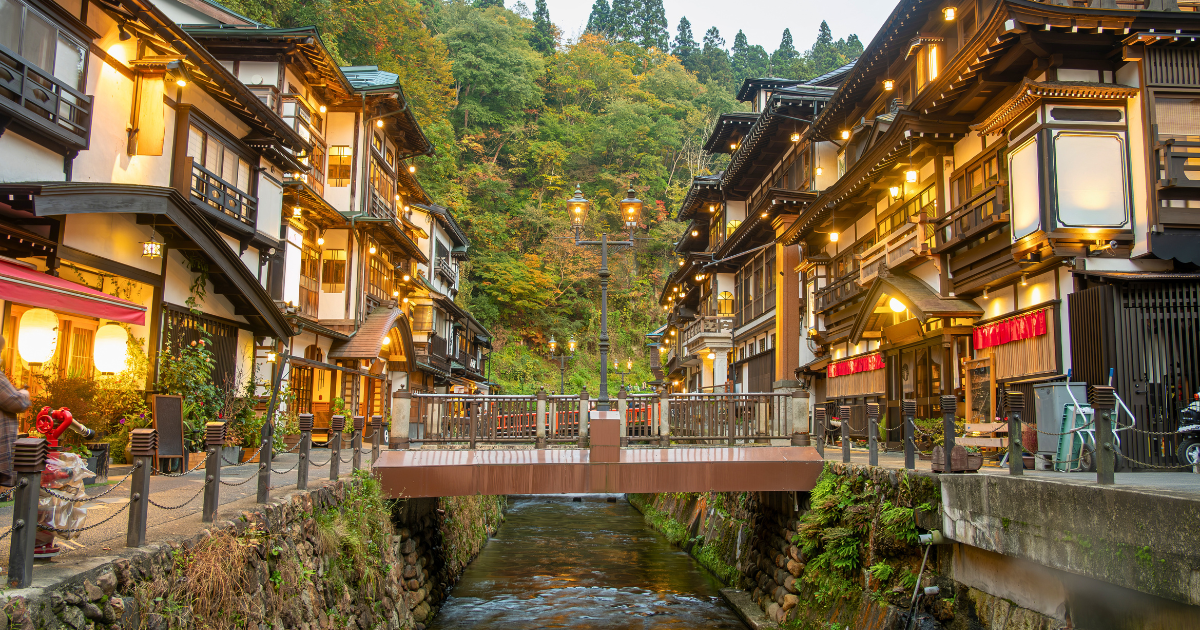
Japan’s onsen culture is rooted in natural hot spring water, with bathing traditions found across onsen towns, mountain valleys, coastal areas and volcanic regions.
What is an onsen?
An onsen is a Japanese bathing facility supplied by naturally occurring hot spring water. The 1948 Hot Springs Law gives the term a specific meaning, the water must emerge from the ground at 25°C or above, or contain at least one of nineteen mineral elements in defined quantities. Without one of those properties, a bath cannot be described as an onsen in Japan - no matter how traditional it looks.
The distinction matters, because onsens are easily confused with other Japanese hot springs and bathing facilities that look similar at a glance. For instance, a sento is a public bathhouse heated with ordinary tap water, usually found in residential neighbourhoods and treated as everyday infrastructure. In contrast, an ofuro is the bathtub used at home, filled and heated within the household. What sets onsens apart is the source itself, with the water rising from geothermal activity and often piped only a short distance from the spring to the bath.
The mineral content of that water gives each onsen its own character. Sulphur springs are common in volcanic areas and carry a strong scent. Iron-rich waters appear reddish-brown and slowly stain the surrounding stone, while alkaline springs feel particularly soft on the skin. These properties are valued enough that ryokans or traditional Japanese inns, often list the mineral profile of their water alongside the temperature, and many travellers within Japan choose where to soak based on the kind of water they want.
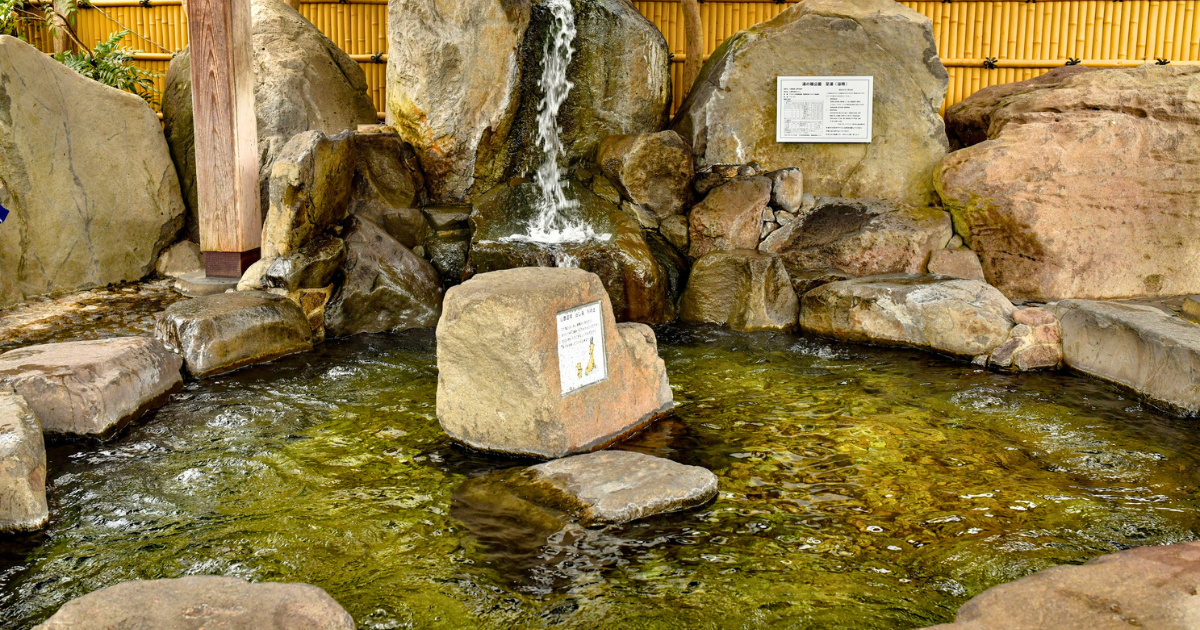
The source of the water is central to onsen culture, with mineral-rich spring water rising naturally from geothermal activity.
The geological and historical roots of onsen bathing in Japan
The onsen tradition rests on two foundations that developed in parallel. One is geological, which explains why Japan has so much hot spring water in the first place. The other is culture, which traces how bathing in those waters became connected into religious practice, medicine and eventually mainstream travel.
Why Japan has so many hot springs
The abundance of hot springs comes from Japan’s position on one of the world’s most active subduction zones, where four tectonic plates push against each other and force magma close to the surface.
The Pacific and Philippine Sea plates slide beneath the Eurasian and North American plates along the archipelago's eastern edge, producing the volcanic activity that heats groundwater throughout the country. This provides Japan with roughly 111 active volcanoes, around 27,000 individual hot spring sources, and close to 3,000 designated onsen areas - all across a country smaller than Germany.
The distribution of hot springs follows the volcanic terrain. Hokkaido in the north has dense concentrations around the Daisetsuzan and Shikotsu-Toya volcanic zones. Nearby, the Tohoku region of northern Honshu sits along a chain of active peaks that includes Mount Iwate, Mount Zao and the Bandai range, all of which feed nearby onsen towns. Kyushu has the strongest geothermal activity of any of the four main islands, with Beppu and Yufuin in Oita prefecture among the most productive hot spring areas in the world.
How onsen bathing became a cultural practice
Bathing in Japan's hot springs began as a religious practice and grew into a wider social one. Early Buddhist and Shinto traditions both treated water as a means of purification, and natural springs were used for ritual cleansing well before they were used for relaxation. References to hot spring bathing appear in the Nihon Shoki, one of the country's oldest written chronicles, compiled in 720 CE.
By the medieval period, the practice had broadened. Samurai used hot springs for healing battle wounds, and farmers developed a seasonal tradition known as toji, in which they would travel to a hot spring town between harvests and stay for one to three weeks, soaking daily for therapeutic effect. Specific onsens became known for treating specific ailments, and the link between water chemistry and health has remained a part of how onsens are understood ever since.
The Edo period brought the most significant expansion. With internal travel restrictions relaxed for certain purposes, dedicated onsen towns grew rapidly, supported by inns, food stalls and entertainment districts. Many of the towns travellers still visit today, including Kusatsu, Arima and Atami, took their modern form in this period. By the time Japan opened to foreign travel in the late nineteenth century, the onsen had already settled into the form most travellers would recognise today.
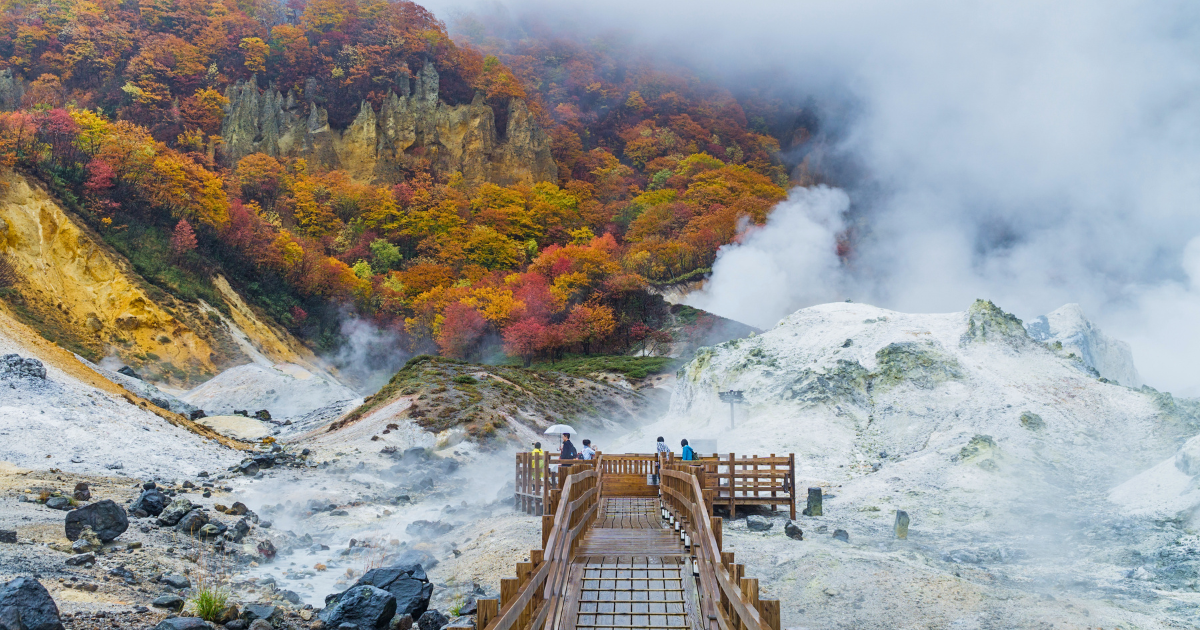
Volcanic landscapes such as Noboribetsu’s Jigokudani help explain why hot spring bathing became so deeply rooted in Japan.
Four types of onsens found across Japan
Onsens vary by setting, ownership and the kind of experience they offer, and most onsen towns include several types within walking distance of each other. There are four types of onsen that almost every onsen a traveller is likely to encounter, and the choice between them often determines the character of a stay.
Uchiyu (indoor baths)
Uchiyu are indoor onsen baths, usually built within ryokan or Japanese inns. They are typically constructed from cypress, granite or volcanic rock, and remain the most common format across Japan because they can be used in any weather. The enclosed setting also makes uchiyu the format most newcomers to onsen bathing encounter first, since they feel more familiar than the open-air alternatives.
Rotenburo (outdoor baths)
Rotenburo are open-air baths, and the type most associated with traditional onsen imagery. They are usually positioned to look out over gardens, rivers, mountains or coastlines, which is why the contrast between hot water and cold mountain air has become one of the defining sensations of a winter onsen visit. To make the most of the setting, many ryokan place their rotenburo on rooftops or carve them into riverside terraces.
Sotoyu (public bathhouses)
Sotoyu are town-run or community-owned onsen bathhouses used by both residents and visitors. They are particularly common in dedicated onsen towns such as Kinosaki and Nozawa, where guests staying at any ryokan are usually given access to all the town's public baths as part of their stay. Because they are cheaper and more communal than ryokan baths, sotoyu offer the closest view of how onsens still function as everyday social spaces.
Kashikiri (private or reserved baths)
Kashikiri baths are private onsens that can be reserved for individual use, usually in 45-minute or one-hour slots. They have become increasingly common in ryokan catering to international guests, couples and families travelling with children. Beyond convenience, kashikiri baths also provide a practical option for travellers with tattoos, and for anyone uncertain about communal bathing.
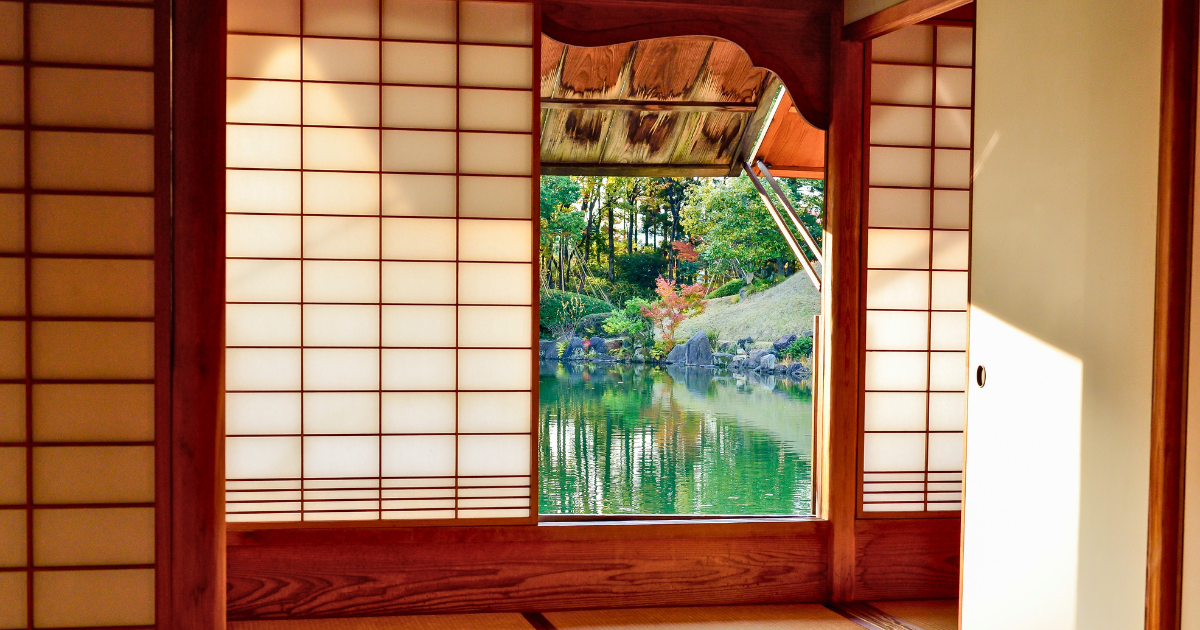
Traditional ryokan rooms are part of the onsen experience, giving guests a quiet place to rest between bathing and meals.
Basic onsen etiquette and rules for visitors
Onsen etiquette reflects a wider Japanese emphasis on consideration in shared spaces. These are social conventions that most Japanese learn from childhood, and following them is part of how the experience is shared comfortably between everyone in the bath. The rules can feel like a lot to take in at first, though they become natural quickly once the underlying logic is clear.
What are the basic rules for entering an onsen?
The most basic onsen rule is to wash thoroughly before entering the bath. Soap, shampoo and scrubbing are done at the seated shower stations along the wall, with hot water rinsed away completely so no traces enter the communal pool. Visitors remove their shoes at the entrance to the bathhouse and proceed to a gender-separated changing room, where clothes and valuables are stored in lockers or open baskets.
From there, bathers enter the washing area carrying only a small towel, which serves two purposes once bathing begins. It can be used for modesty when walking between the washing area and the bath, but it must never touch the water, so most bathers leave it at the edge of the bath or fold it on top of their head while soaking. Soak times usually run to 10 or 15 minutes per session, with breaks taken outside of the water to cool down between rounds. Most onsens allow multiple soaks separated by short breaks at the edge of the pool.
Do you have to be fully naked in an onsen?
Yes, traditional onsens require bathers to be fully unclothed. Swimwear is not permitted, and the practice is universal across virtually all onsens in Japan, including those at ryokan, public bathhouses and resort hotels. The convention reflects both hygiene principles and the cultural concept of hadaka no tsukiai, meaning naked communion, the idea that bathing together puts people on equal footing. In terms of hygiene, swimwear also retains soap, sweat and fibres that affect the cleanliness of the shared water.
In practice, baths are almost always separated by gender, marked by blue noren curtains for men and red for women. Mixed-gender onsens, known as konyoku, still exist in remote rural areas and at a small number of traditional baths, though their numbers have declined considerably over the past few decades.
How should you behave inside the bath?
Conversation inside an onsen is typically quiet and reserved, since the bath functions as a space for physical and mental decompression. Loud voices, splashing and group conversation are considered disruptive, particularly in ryokan baths where guests often visit early in the morning or late at night. Phones and cameras are forbidden in all bathing areas, both to protect privacy and because the moisture damages devices.
The same principles apply to physical conduct in the water. Long hair must be tied up or wrapped so that it does not touch the bath, and bathers do not swim, dive or push themselves through it. After the soak, visitors return to the washing area to rinse off if they wish, then dry themselves thoroughly before re-entering the changing room, since keeping the changing area floors dry is a courtesy to the next bathers.
What are the onsen rules on tattoos?
Many traditional onsens in Japan prohibit visible tattoos, a rule rooted in the historic association between tattoos and the yakuza, Japan's organised crime networks. The ban was originally intended to keep gang members out of public bathing spaces, and although the association has weakened considerably, the rule itself remains in place at many onsens across the country. Onsens in international tourist regions, including parts of Hakone, Kinosaki and Beppu, have either relaxed their rules or introduced tattoo-friendly designations.
For travellers with tattoos, there are several practical options. Small tattoos can be covered with adhesive skin-coloured stickers sold at chemists across Japan. Larger tattoos generally require booking a kashikiri (private) bath, or staying at a ryokan with an in-room onsen. Both approaches are widely used and easy to arrange in advance.
Can foreigners go to onsens in Japan?
Yes, foreigners are welcome at the great majority of onsens in Japan. A small number of rural or traditional facilities still operate Japanese-only policies, usually because the staff lack the language or experience to manage etiquette explanations, but these are now the exception rather than the rule. Onsens at major ryokans, hotels and busy tourist-town facilities typically post instructions in English, and staff are used to walking foreign guests through the basics on arrival.
The etiquette is also less daunting in practice than it sounds, since other guests are focused on their own bathing rather than watching newcomers. Ryokans with bookable kashikiri baths are often the easiest starting points for anyone new to onsen bathing, especially when included as part of a guided Japan cultural tour.
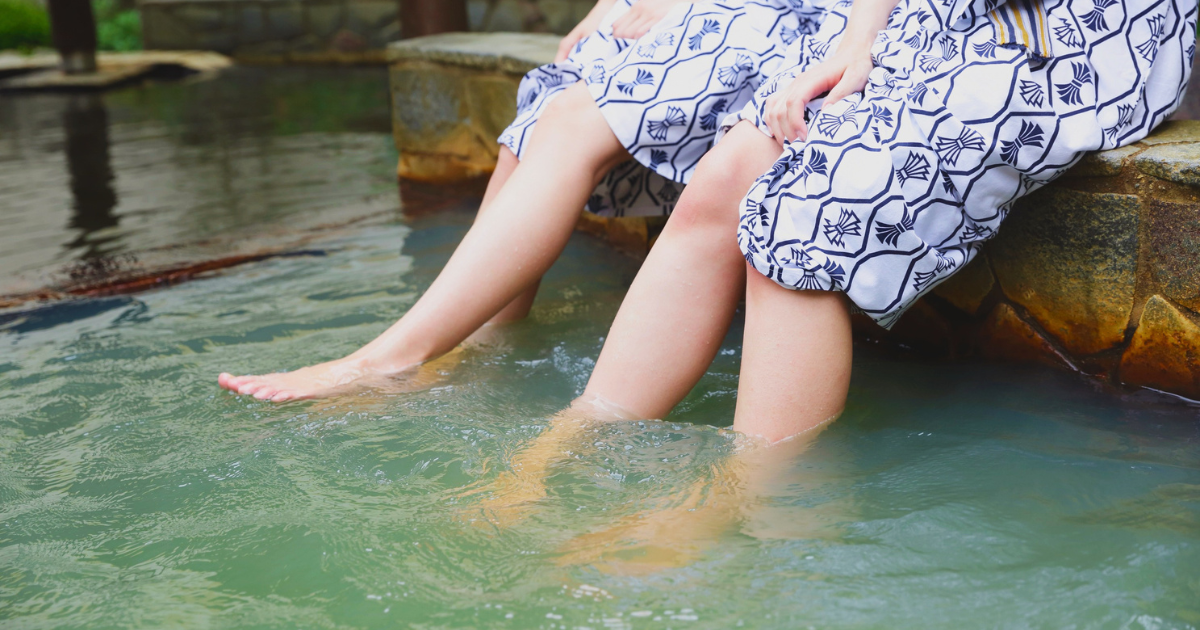
Visitors are expected to follow quiet, considerate routines in onsen spaces, including proper washing, careful changing and wearing yukata around the ryokan.
Five regions in Japan with incredible onsens
Japan has thousands of onsen towns, but a smaller number have built reputations significant enough to anchor a longer regional itinerary. The five below cover different parts of the country and different bathing traditions, and each works well as a base for two or three nights as part of a wider Japan trip.
Hakone
Hakone sits roughly 80km southwest of Tokyo in the volcanic mountains of Kanagawa prefecture. The area contains seventeen distinct onsen districts, which together produce the highest hot spring output of any region near the capital, and clear-weather views of Mount Fuji are part of the appeal at the higher elevations.
Most ryokans in the area include rotenburo (open air baths) fed directly from local springs, and Hakone has been used as a retreat from the capital since the Edo period, when the route through the mountains formed part of the old Tokaido highway. The region is reached directly by rail from Shinjuku in about 90 minutes, which makes it the most accessible onsen destination for travellers arriving through Tokyo.
Kusatsu
Further inland, Kusatsu in Gunma prefecture is known for its sulphur-rich, highly acidic waters and for the yumomi tradition, in which long wooden paddles cool the bath water by hand while performers sing traditional songs. The water rises from the ground at around 55°C, which is too hot for direct bathing, and yumomi was developed as a way of cooling it without diluting the mineral content.
At the centre of the village sits the yubatake, a wooden hot spring field that releases steam through the streets day and night, and the surrounding bathhouses draw their water directly from it. Kusatsu is often counted alongside Arima and Gero as one of Japan's three most significant onsen towns.
Beppu
Beppu in Oita prefecture has the largest hot spring output of any city in Japan, with more than 2,000 individual hot spring vents within and around the city. It is best known for the jigoku, or eight hells, a series of brightly coloured geothermal pools too hot for bathing and visited as a sightseeing route instead.
The wider city contains bathhouses across eight onsen districts known collectively as Beppu Hatto, each with a distinct water type, including clear hot springs, iron-rich brown waters, hydrogen carbonate springs and the mineral mud baths of Myoban. Sand baths are another local speciality, with bathers buried up to the neck in volcanically heated sand instead of soaking in water.
Noboribetsu
Noboribetsu, in southern Hokkaido, sits below Jigokudani, a valley of steaming vents that supplies nine different types of mineral water to the bathhouses and ryokan in the town. This variety is very unique even by Japanese standards, with sulphur, iron, salt and alum springs all rising within a short distance of one another.
The Ainu, Hokkaido's indigenous people, used the springs long before Japanese settlement of the island and named the area Nupur-pet, or "cloudy river", after the way the mineral water discolours the local stream. Winter visits offer the contrast of steam from the valley against snow on the surrounding forest, with most ryokan providing outdoor baths positioned to face the view.
Kinosaki
Kinosaki, on the Sea of Japan coast in Hyogo prefecture, retains the atmosphere of a classic onsen town more than almost anywhere else in Japan. Seven public bathhouses sit along willow-lined canals, and guests staying at any of the town's ryokan receive a pass to use all of them.
Bathers move between the baths in yukata robe and wooden geta sandals through the evening, and a long-standing local agreement among the inns has kept modern development out of the historic centre. The town is reached in around 2.5 hours by limited express train from Kyoto, and is particularly busy in winter when Sea of Japan crab is in season.
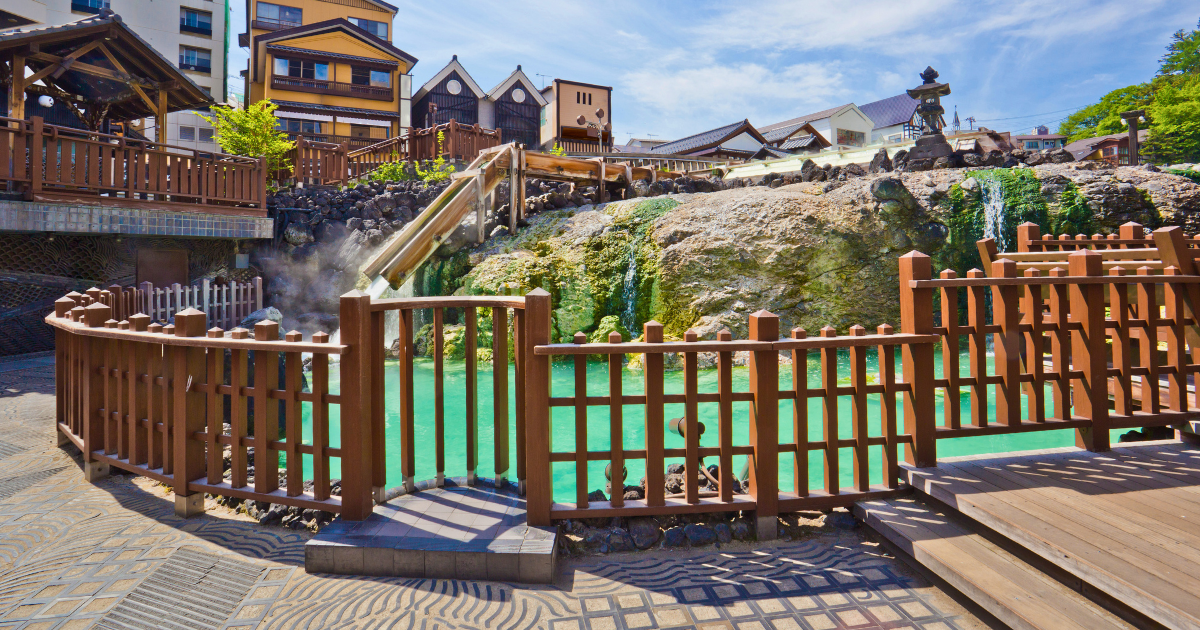
Kusatsu is one of Japan’s best-known onsen towns, with the yubatake at the centre of its hot spring culture.
Experiencing onsens in Japan with Remarkable East
Remarkable East designs small group journeys across Asia with a maximum of 12 guests on every departure, accompanied by experienced hosts who provide regional context throughout. Looking for a Japan tour that includes traditional ryokan stays and time in onsen towns? Contact our team to know the itinerary details and departure date.